Mark started a remodeling and construction company in March. Five-person crew, mostly interior finishing and light structural work. He budgeted "generously" for tools — $30,000. He thought that was plenty.
By June, three months into the business, he tallied up his spending on tools and equipment. Receipts, invoices, credit card statements. The total: $78,000. And he was still missing a few things.
"I had no idea how much it all costs when you add it up," Mark says. "I planned for drills and grinders, but forgot about lasers, ladders, a shop vac, storage cases, and hundreds of small hand tools. Each one affordable on its own — together, a fortune."
This is a typical story. Construction business owners budget for power tools — because those are "the big expenses." Then everything else blindsides them. Measuring equipment, safety gear, transport, consumables, hand tools for every worker.
This article is a complete breakdown — from the drill to the toolbox. Real prices from the US market in 2025, specific models, practical categories. So the next Mark knows what he's signing up for before he signs his first contract.
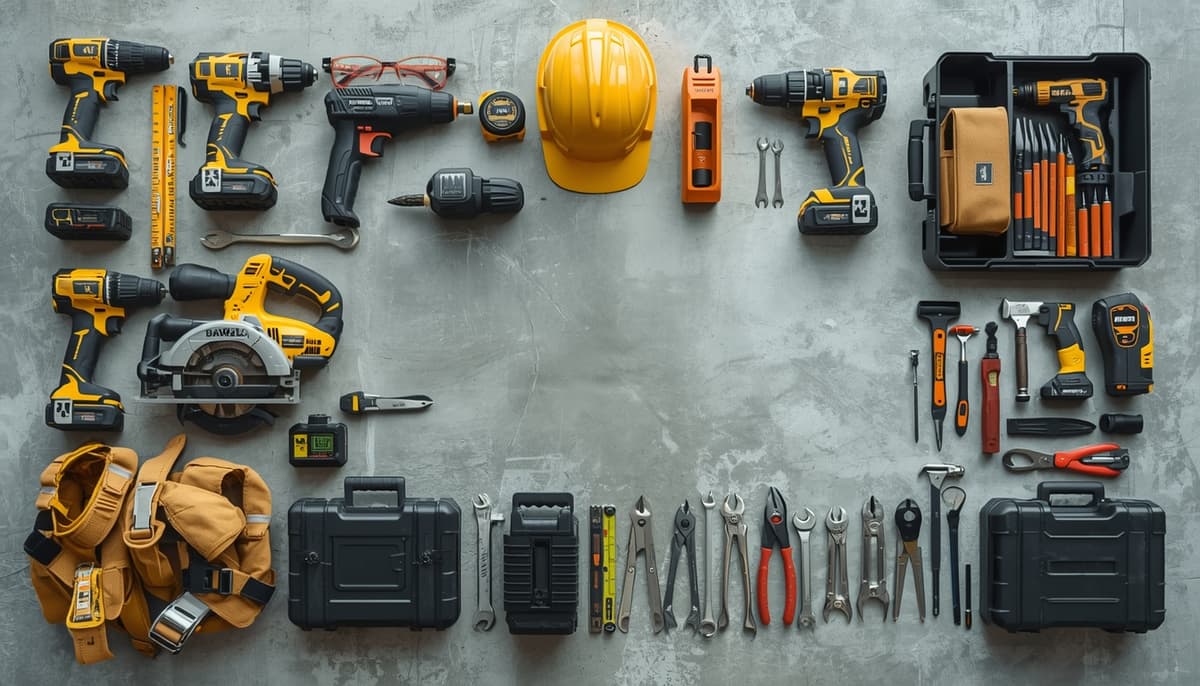
Core power tools
This is the backbone of your equipment. Without these, a remodeling crew doesn't start work.
Cordless drill/drivers
The absolute essential. Every worker needs their own — sharing a drill is a recipe for downtime.
- Budget tier (Bosch GSR 18V-50, Makita XFD14): $150–$250 for a kit with 2 batteries
- Professional tier (DeWalt DCD791, Milwaukee M18 FUEL): $250–$400
- Premium tier (Hilti SF 6H-A22, Festool TPC 18/4): $500–$700
For a 5-person crew: 5 units. The realistic pick is professional tier. Budget models don't survive heavy daily use, and premium is overpaying when you're starting out.
Cost: 5 × $350 = $1,750
Rotary hammers (SDS+)
For drilling into concrete and masonry. Two per crew is enough — not everyone drills at the same time.
- Bosch GBH 2-28 F: $350
- Makita HR2631F: $280
- DeWalt D25133K: $250
- Hilti TE 3-C: $550
Cost: 2 × $300 = $600
Angle grinders
Minimum 2 units: one 5-inch (for cutting and grinding), one 9-inch (for bigger cuts).
- 5-inch: Bosch GWS13-50VS ($180), Makita GA5040C ($170)
- 9-inch: Bosch GWS13-230 ($250), DeWalt DWE4559 ($200)
Plus cordless grinders for lighter work — 2 units at $200–$300 each.
Cost: 4 grinders total ~$900
Saws
This is where costs spread out — depending on what jobs you take.
- Circular saw (Makita 5007MGA, Bosch GKS190): $200–$300
- Jigsaw (Bosch GST 150 CE, Makita 4351FCT): $200–$280
- Reciprocating saw (Milwaukee M18 FUEL SAWZALL, DeWalt DCS367): $250–$400
- Oscillating multi-tool (Fein MultiMaster, Bosch GOP 40-30): $200–$300
You won't need all of them right away — but within a year, you'll own them all.
Cost to start: circular + jigsaw + recip = ~$800
Other power tools
- Shop vacuum (Makita XCV11, DeWalt DWV012): $250–$500. Non-negotiable — without one, clients won't let your crew back into their home after the first day.
- Mixing drill (Bosch GRW 18-2 E): $350
- Cordless caulking gun: $100–$200
Cost of remaining tools: ~$800
Total power tools: ~$4,850
Measuring equipment
The category that new business owners routinely leave out of the budget. But without it, you can't set a straight wall.
Cross-line laser
The fundamental tool for finish work. Without a laser, you can't align tile, frame a partition wall, or mount cabinets level.
- Basic (Bosch GCL 2-15, DeWalt DCE088D1G): $200–$350
- Professional with outdoor receiver (Bosch GLL 3-80, Makita SK700GD): $500–$900
A basic model is fine to start. You'll need a professional one when you take on exterior work.
Cost: $300
Leveling instrument
For foundation work, floor pours, and site grading. If you only do interior finishing — not a day-one buy. If you're doing floors, foundations, or slabs — mandatory.
- Optical level (Bosch GOL 26 D): $300
- Rotary laser level (Bosch GRL 300 HV): $900–$1,200
Cost: $300 – $1,200 (depends on your scope)
Laser distance measurer
For quick measurements on the job site. A tape measure works fine for three or four feet, but measuring a 16×13 room with a laser takes 3 seconds vs. a minute with a tape.
- Bosch GLM 50-27 CG: $150
- Leica DISTO D2: $180
- Makita LD080P: $130
Two per crew — because they get lost, broken, and somebody always needs one.
Cost: 2 × $150 = $300
Stud finder / wire detector
Before drilling into a wall, you need to know if you'll hit a live wire or a water pipe. One mistake costs more than ten detectors.
- Bosch GMS 120: $130
- DeWalt DCT419S1: $150
Cost: $130
A $50 laser from the big-box store won't hold plumb after a 3-foot drop and will drift 1/8 inch over 15 feet. A professional unit holds accuracy to 1/32 inch at 30 feet and survives a job site. The $250 difference at the start vs. tearing out and redoing crooked tile that costs $2,000 after the first month.
Total measuring equipment: ~$1,030 – $1,930
Hand tools
The small stuff that adds up to a serious number. Every worker needs their own basic set.
Per-worker set
- Tool belt or vest: $50–$100
- Screwdriver set (Wera Kraftform, Klein Tools): $60–$120
- Socket set (1/4" + 1/2"): $80–$160
- Combination wrench set: $60–$100
- Framing hammer + mason's hammer: $50–$80
- Spirit levels (24 in. + 48 in.): $60–$120
- Tape measures (2 pcs): $20–$40
- Utility knife: $10–$20
- Pliers (linesman, diagonal, channel-lock): $50–$100
- Hand saw, chisels, putty knives: $60–$100
Total per worker: $500 – $940. Realistically, with professional-grade picks: ~$600.
Shared tools (shop / van)
- Hex key set: $30
- Bench vise: $60–$120
- Bar clamps, woodworking clamps (set): $80–$150
- Putty knives, brushes, rollers (starter set): $60
- Cold chisel, center punch, pin punch (set): $30
- Extension cords (3 × 100 ft): $100–$180
- Portable power distribution box (spider box): $150–$300
- Pry bar, spade, wheelbarrow: $100
Shared tools total: ~$650 – $970
Total hand tools: 5 × $600 + $800 = ~$3,800
Safety and access equipment
Ladders
Without a ladder you can't reach the ceiling in an apartment. Without scaffolding you can't paint a facade.
- Aluminum extension ladder (16 ft): $200–$350
- Multi-position ladder: $200–$350
- Work platform / sawhorse (× 2): $80–$150 each
Cost: ~$700
Scaffolding
Here's the question: buy or rent?
Exterior scaffolding (full set for 20 ft height, ~300 sq ft working area):
- Purchase: $3,000 – $6,000
- Rental: $300–$600 / month
If you use scaffolding less than 4–5 months a year — rent. If more — buy. The break-even point for typical scaffolding: rental makes sense up to ~10 months of use, after that owning is cheaper.
Interior scaffolding (rolling tower):
- Purchase: $800 – $1,500
- Rental: $100–$200 / month
Cost (rolling scaffold + ladders): ~$1,800
Personal protective equipment (PPE)
Employer's obligation. You can't pass this cost onto workers.
- Hard hats: $15–$30 × 5 = $75–$150
- Safety glasses: $10–$25 × 5 = $50–$125
- Earmuffs / ear plugs: $10–$20 × 5 = $50–$100
- Work gloves (quarterly supply): $10 × 5 × 4 = $200/year
- Work boots (ASTM-rated): $100–$200 × 5 = $500–$1,000
- High-visibility vests: $8 × 5 = $40
- First aid kit: $40
PPE cost at startup: ~$1,000 (then ~$500/year for replacements)
Total safety and access: ~$3,500
Specialty tools - buying vs. renting
You don't need to own everything. Equipment you use occasionally is better rented.
Worth buying (frequent use)
- Wall chaser (for routing channels for wiring/plumbing): Makita SG1251J ($550), Bosch GNF 35 CA ($700). If you do installations — pays for itself by the third job.
- SDS-max demolition hammer: DeWalt D25871K ($800), Bosch GSH 11 VC ($1,100). With demo work once a month — pays for itself in six months vs. renting.
Worth renting (occasional use)
- Plate compactor (for sub-base): purchase $2,500–$5,000, rental $80–$120/day. Rent unless you're doing sub-base work every week.
- Concrete mixer: purchase $800–$1,500, rental $60–$100/day. Similar math.
- Power trowel (for concrete finishing): purchase $1,500–$3,000, rental $100–$200/day. Definitely rent unless you specialize in concrete slabs.
- Hoist / chain hoist: purchase $800–$1,800, rental $80–$150/day.
Rule of thumb: if you use a piece of equipment less than 30 days a year — rent it. Over 30 days — do the math carefully, but you'll probably save by buying.
Cost of specialty tools at startup: ~$1,500 (wall chaser + demo hammer)
Transport and organization
The category Mark didn't think about at all — and it cost him more than he expected.
Tool storage and organizers
Tools loose in the van is a recipe for damage and chaos. Proper organization is an investment that protects tens of thousands of dollars worth of equipment.
- Modular case systems (Bosch L-BOXX, Makita MAKPAC, DeWalt TSTAK): $40–$80 per module. A crew needs 8–12 modules = $400–$800
- Power tool cases (usually included with the tool kit): $0 if you buy kits
- Van shelving: $500–$1,000 (ready-made system like Adrian Steel or Ranger Design) or $200–$300 (DIY with aluminum extrusion)
- Hand tool boxes (per worker): $50–$100 × 5 = $250–$500
Cost of transport organization: ~$1,500
Work van
This is a separate topic, but it has to be factored into the calculation. A 5-person crew with full gear needs at minimum a cargo van — Ford Transit, Ram ProMaster, or Mercedes Sprinter.
- Used (3–5 years old): $25,000–$40,000
- New: $45,000–$55,000
- Lease: $800–$1,200 / month
The van is usually the single biggest startup cost. But without it, you can't get the crew or the tools to the job site.
Hidden costs - what Mark didn't plan for
Consumables
Grinding discs wear out. Drill bits go dull. Driver bits snap. Jigsaw blades need replacing.
Realistic consumable costs: $500–$800 per month for a 5-person crew. That's $6,000–$10,000 per year. An amount that never shows up in any "tool cost breakdown" but eats your budget alive.
Sample prices:
- Metal cut-off disc (5 in.): $2–$4 each (usage: 2–5 per day)
- Diamond blade for concrete: $25–$80 (lifespan: 20–50 cuts)
- SDS+ drill bit set (5 pcs): $40–$80 (replacement every 2–3 months)
- Driver bit set (30 pcs): $20–$40 (replacement every month)
Service and repairs
Power tools break. With daily use on a construction site — more often than the manufacturer says.
Annual service cost: 8–15% of your power tool value. With $5,000 in power tools, that's $400–$750 per year. This covers: brush replacement, bearings, damaged housings, laser recalibration. A regular tool inspection and maintenance schedule keeps these costs down - a minor fix during an inspection is far cheaper than a breakdown in the middle of a job.
Plus surprises: a dropped drill, a soaked grinder, a stolen laser. Knowing how to prevent tool loss on construction sites helps, because replacement isn't the only cost - there's also the search time, downtime, and rush purchases. Contingency reserve: $1,000–$1,500 per year.
Measuring equipment calibration
Lasers and levels need periodic calibration — typically once a year. Cost: $50–$150 per unit. With three lasers and a level: $200–$600 per year.
Without calibration, you're risking measurement errors that cost many times more.
Consumables, service, calibration, and unexpected expenses add up to $8,000 – $13,000 per year. That's as much as the power tool budget at startup. Companies that don't plan for this discover mid-year that "tools ate the entire budget" — and that's just operating costs, not purchases.
Summary table: budget for a 5-person crew
| Category | Cost |
|---|---|
| Core power tools | $4,850 |
| Measuring equipment | $1,500 |
| Hand tools (5 workers + shared) | $3,800 |
| Safety, ladders, PPE | $3,500 |
| Specialty tools (startup) | $1,500 |
| Transport and organization | $1,500 |
| TOTAL - startup equipment | $16,650 |
| Consumables (annual) | $8,000 |
| Service and repairs (annual) | $1,000 |
| Calibration (annual) | $400 |
| Contingency reserve (annual) | $1,200 |
| Annual operating costs | $10,600 |
| First-year total | ~$27,250 |
This breakdown does not include the van (a separate investment category) or exterior scaffolding (rental per project).
How to lower costs without compromising on quality
Buy kits, not individual tools
A drill/driver kit with two batteries and a case runs $350. The same items purchased separately: $450–$500. That's 20–30% in savings.
Manufacturers offer "bare tool" options (no batteries) for companies that already have batteries in that system. Makita 18V LXT, DeWalt 20V MAX, Milwaukee M18 — if you standardize on one battery platform, each additional tool costs 30–40% less.
Standardize on one battery platform
One battery system for the entire company. Don't mix Makita with DeWalt and Milwaukee — you'll end up with three battery types, three chargers, and zero interchangeability.
Pick one system and stick with it. Batteries swap between tools in the same ecosystem — so you buy fewer batteries, fewer chargers, fewer headaches.
Don't buy everything at once
Start: core power tools + measuring gear + hand tools. That's the minimum to get going.
Month 2–3: specialty tools — as specific jobs come in. Don't buy a wall chaser "just in case" — buy it when you land an installation contract.
Month 4–6: replacements and restocking. This is when recurring operating costs kick in.
Use your warranties
Professional power tools come with 2–3 year warranties (Bosch Professional — 3 years with registration, Makita — 3 years, DeWalt — 3 years, Hilti — 2 years with fleet service). Use them.
Register tools with the manufacturer on the day of purchase. Keep your receipts. Document the purchase date. A warranty you can't claim because you lost the receipt — that's money thrown away.
Consider refurbished equipment
Brands like Hilti offer fleet programs where they refresh equipment every 2–3 years. The old gear goes to the secondary market — functional, serviced, 40–60% cheaper than new. Hilti Outlet, DeWalt Factory Refurbished, Milwaukee Reconditioned — these are legitimate sources of proven equipment at lower prices.
Mark after one year - actual spending vs. the plan
Let's come back to Mark from the beginning. Plan: $30,000. Reality after three months: $78,000. And after a year?
Mark tallied his first year of business. Total spending on tools, equipment, and operating costs: $91,000. Including:
- Purchases at startup and during the first three months: $78,000
- Consumables (9 months): $7,200
- Service and repairs: $2,800
- Replacing damaged and lost tools: $3,000 (we covered how much lost equipment really costs in a separate breakdown)
"If I'd known ahead of time, I would've budgeted $80,000–$90,000 for the first year and avoided the panic in May when the money ran out and I still needed a laser and a wall chaser," Mark says.
His advice for newcomers: "Take your most optimistic estimate and multiply by two. You'll be closer to the truth than with any spreadsheet. And then calculate what consumables cost — because that's the expense that never stops."
Tools aren't a one-time purchase. They're an ongoing investment that grows with your business. The first year is the most expensive because you're buying everything from scratch. The second year is mostly operating costs, restocking, and the occasional new tool. From year three, you start replacing worn-out equipment with new — and the cycle repeats.
A well-planned budget won't protect you from surprises. But it will make the surprises smaller — and a lot less painful.