Rob Castillo's morning started with coffee and a spreadsheet. Every January, the owner of a Denver-based framing company sat down and reconciled his tool purchases against what he currently owned. For nine years, he skipped it — too busy, too tedious, didn't seem urgent.
In year ten, he finally did the math.
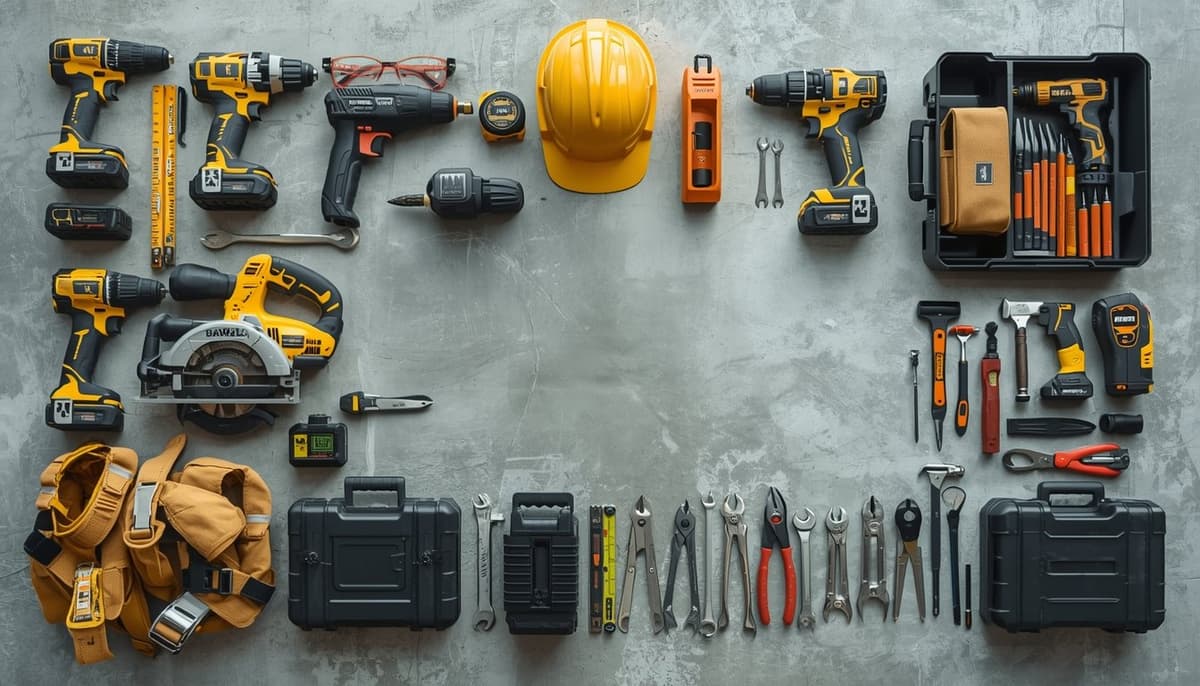
$32,000. That's how much in tools had vanished across job sites since he started the business. Drills, lasers, grinders, a Hilti rotary hammer, two Bosch miter saws, impact drivers — gone. Not stolen in some dramatic heist. Just... gone.
"I figured maybe $8,000," Rob told me over the phone. "You don't feel it day-to-day. A drill here, a laser there. Each one on its own feels minor. But over ten years?"
He let the silence say the rest.
Rob isn't the exception. He's the norm. If you've ever wondered how much it really costs to equip a construction crew, the answer hurts even more when you realize a chunk of that investment walks off the job site every year.
Why construction sites eat tools alive
A construction site is the perfect environment for losing things. Multiple floors, constant movement of people and gear, subcontractors rotating in and out, time pressure that makes everyone rush, and no permanent storage.
Nobody plans to lose a tool. The mechanism is simpler and more human than that.
Monday morning at Rob's site in Lakewood. His framer, Tom, grabs a DeWalt cordless drill and hauls it up to the third floor to hang blocking. Finishes the job, heads downstairs for a water break. The drill stays on the third floor. An electrician's helper sees it, picks it up, uses it to mount a junction box on the second floor. Sets it down in a corner. End of day, that drill is sitting behind a stack of drywall on the second floor. Nobody knows it's there. Nobody looks for it, because "it's probably in the van."
Multiply that by twenty tools and five days a week.
40% — left at a workstation and forgotten. 25% — "borrowed" by subcontractors and never returned. 20% — in workers' vans and personal vehicles. 10% — damaged and tossed without reporting. 5% — actual theft.
Sound familiar?
Rob knew the pattern by heart. He just didn't know how to break it — until he decided to try everything.
The first decision — one tool, one name
Rob started with the simplest rule he could think of. Every tool worth more than $100 got assigned to a specific person. Not to a crew, not to a job site — to an individual by name, documented through a tool handover protocol and backed by clear employee liability rules.
Tom got drill DR-015. From that moment, it was Tom's drill. He knew he needed to have it at the end of every shift. He didn't lend it to Dan without making sure he got it back — because his name was on the line, not Dan's.
The effect was immediate. Workers started keeping track of "their" tools. Not because Rob threatened anyone. Because ownership changed behavior.
"Borrowing" didn't stop, but it changed character. Tom would lend Dan the drill, then track Dan down at lunch to get it back. Before, that drill belonged to nobody — and nobody's stuff disappeared first.
Rob told his crew at a Monday morning meeting. Fifteen minutes, no drama, no lecture. "Every tool gets a name on it. You're responsible for yours. That's it."
Within a week, the tone on the job site shifted.
Building the habit — five minutes before quitting time
The second thing Rob introduced was a daily check. Five minutes before the end of every shift, each worker verified their assigned tools. Something missing? They looked for it right then, while everyone was still on site — not the next morning, when the person who last touched it might already be across town.
The first week, Rob's foreman, Sarah, had to remind everyone. The second week, most guys did it on their own. By the third week, it was just part of the rhythm — pack up, check your tools, clock out.
One rule Rob drilled into his crew: never penalize someone for losing a tool. Penalize them for not reporting it. A worker who says "I can't find the grinder" at 3:45 p.m. gives you a chance to search. A worker who stays quiet and hopes it'll turn up? That's the real problem.
How many tools at your site are missing right now — and nobody's said a word?
The stickers that changed everything
A month in, Rob ordered QR labels. Two hundred laminated stickers, $35 total. He spent a Saturday morning applying them — one on the side of every tool's housing, near the manufacturer's plate, avoiding spots prone to heat and abrasion.
A QR sticker turns a tool from an anonymous object into something trackable. A phone scan shows whose it is, when it was checked out, where it should be.
But QR codes do something else — something psychological. A tool with a code on it looks monitored. A subcontractor who might "forget" to return an anonymous grinder will think twice about a grinder with an inventory number staring back at him.
Use laminated labels — paper ones won't survive a week. Apply them on the side of the housing, near the manufacturer's plate, or on the underside of the handle. Avoid spots prone to abrasion, heat, and contact with solvents.
The cost: $35 for 200 labels. One lost angle grinder costs $250 to $500. The math speaks for itself.
Rob's biggest job site — zero losses
Rob's fourth move was a lockable tool container on his largest project, a 24-unit townhome build in Aurora. He converted a steel shipping container into a tool room, assigned his most organized crew member, Jake, as the gatekeeper.
Tools went out in the morning, came back in the evening. Every checkout and return — logged. Jake knew what was out and who had it.
Adding a tool manager to a large site costs money. But on a project with $55,000 worth of equipment, the cost of Jake spending an hour a day on tool management was a fraction of the $3,500 Rob had been losing per year.
Losses on the Aurora site over eight months: zero tools. On Rob's other sites, without a container: four to five tools per month, same as always.
That contrast told Rob everything he needed to know.
The subcontractor problem
Subcontractors were Rob's biggest headache. They'd show up, do their work, and leave — with access to his tools but no reason to care for them.
Rob set three rules.
Rule one: subcontractors bring their own tools. Period. If they needed something of Rob's, they filled out a checkout form with a signature and a return date.
Rule two: for bigger sub crews, Rob designated a single point of contact. Not "Martinez Plumbing borrows a pipe wrench." Instead, "Carlos Martinez from Martinez Plumbing borrows pipe wrench PW-008, and Carlos Martinez returns it."
Rule three: the final invoice doesn't get paid until every tool is accounted for. Rob told this to every sub on day one of every project. "Return my tools, get your check. Simple."
"That last one is the only language that truly works," Rob said, half laughing. "Everything else is a request. Holding the check is a contract."
Paint it orange — low-tech, high impact
Rob's sixth method was the oldest trick in the book. He spray-painted every tool safety orange. One Saturday, two cans of Rust-Oleum, done.
A bright orange Milwaukee grinder is hard to "confuse" with someone else's. Hard to take "by accident." Hard to resell, because it stands out on a shelf at any pawn shop.
On a cluttered job site, that orange paint did something unexpected — it made tools easier to spot. A neon grinder behind a sheet of plywood catches your eye. A gray one blends into the dust.
No technology required. Just a can of spray paint and an hour.
Tying it all together — one screen, every tool
Each of those methods worked on its own. Together, they formed a system. But a system needs a hub — a place where assignments, QR codes, checkout history, and alerts all connect.
Rob set up an online tracking system that ran on phones. His foreman, Sarah, could open her phone at 7 a.m. and see: 47 tools at the Aurora site, 32 at the Lakewood remodel, 15 in the warehouse. Drill DR-015 with Tom since Tuesday. Laser LS-003 was supposed to come back yesterday — the system sent a text automatically.
Digital tracking alone reduces losses by 30-40%. Tracking + assigned responsibility + daily checks = 70-90% reduction. Rob, after implementing all seven methods, brought annual losses down from ~$3,500 to ~$300.
The real price tag of a "missing" grinder
One thing Rob learned is that a lost tool costs far more than its sticker price. The hidden costs of lost equipment multiply fast.
A $250 angle grinder goes missing. That's $250, right?
Not quite. Add the foreman spending 30 minutes searching. Two workers stopping for 15 minutes each to help look. That's an hour of labor — roughly $50. Downtime if someone was waiting on that grinder: $30 to $100. An emergency run to Home Depot plus drive time: $30. Paperwork: $20.
The real cost of a "$250 grinder": $380 to $450.
Multiply that by two or three lost tools a month, twelve months a year.
If you're ready to put these methods into practice with QR codes, assigned ownership, and automatic alerts — try Toolero. Free for 14 days, no credit card required.
Where Rob stands today
Rob didn't implement all seven methods at once. He started with two — assigned responsibility and a daily check. Cost him zero dollars and one fifteen-minute meeting.
After a month, losses dropped by half. Encouraged, he added QR codes and the tracking system. Two months later — the container on the Aurora site and the new rules for subs. The orange paint came last, almost as an afterthought.
Today, a year later, Rob loses about $25 worth of tools per month. A year ago, it was over $300.
"$32,000 in ten years," he says sometimes, shaking his head. "If I'd started in year one, I'd have an extra Chevy Silverado and a full stockroom by now."
He pauses.
"But better to start today than count losses for another decade."
Tools disappear on your job sites too. The question isn't whether — it's how much. And whether you're ready to change that.