Monday, 7:10 AM. A machine shop outside Cleveland. Mike, a CNC operator with eight years on the job, needs a 40-200 Nm torque wrench. He needs it to secure a chuck on the lathe — without it, production doesn't start.
The wrench should be in the tool cabinet. It's not. Mike checks the next cabinet. Empty slot. He looks under the workbench — three hex keys, a screwdriver, an empty coffee cup. No torque wrench.
He asks around. "Maybe Dave from second shift took it." "Check station 4, someone left stuff there." "I think I saw it Friday in the break room."
Break room. A locker. Sitting on a shelf, next to a mug and a newspaper. Someone put it down "for a sec" on Friday and left for the weekend.
Time spent searching: 22 minutes. Cost of CNC station downtime: $75 an hour. Simple math — half an hour looking for a tool on a machine that bills $300 an hour cost the company more than the wrench itself over the course of a month.
And it happens again. Every day. Every shift. In every shop that doesn't have a system.
Toyota had the same problem
In the 1950s, Japanese factories were dealing with the exact same chaos. Production floors cluttered with unnecessary tools, no designated locations, operators wasting hours searching for equipment. The Toyota Production System solved it with a method that's now a global industry standard.
The 5S method — five Japanese words starting with "S," five steps that turn disorder into a system. It doesn't require software, expensive investments, or consultants. It requires consistency.
Seiri, Seiton, Seiso, Seiketsu, Shitsuke. In English: Sort, Set in Order, Shine, Standardize, Sustain.
Sounds simple. Because it is simple. The hard part is execution — but we'll get to that.
Step 1: Seiri - Sort
The first S asks the most brutal question: does this tool actually need to be here?
Walk into your workshop and really look around. On the benches, in the cabinets, on the shelves, under the machines. How many of those tools were used in the last month? In the last quarter? How many have been sitting there for a year without anyone touching them?
In a typical shop, 20-30% of tools in the work area haven't been used in over three months. They take up space, make it harder to find what you actually need, and create the illusion of order where there's really chaos. To know what you actually have and what condition it's in, start with a proper tool inventory audit - it's the foundation without which sorting is just guesswork.
The red tag method
This is the classic sorting tool. Here's how it works:
Walk through the entire shop with a roll of red stickers. Every tool whose purpose you're unsure about, or that hasn't been used in the last month — slap a red tag on it. Write the date and a short note: "32mm socket wrench - not used since March."
Move all "red" items to a designated zone — a separate shelf, a rack, even a corner of the shop. That's the quarantine zone.
Give it 30 days. If someone needs a tool from quarantine during that time — they remove the tag and the tool goes back to the floor. If after 30 days the tag is still on — the tool doesn't belong in this location.
What about the extras? Three options: move to central storage (if it's needed occasionally), transfer to another department (maybe they need it), or dispose of it (sell, scrap, donate).
"What if we need it next month?" — you'll hear this a hundred times. The answer: if nobody used it in 3 months, the odds of a sudden need are minimal. And even if it happens — the tool is in central storage, not on Mars. What's worse is when the tool you actually need gets buried in a pile of stuff nobody uses.
Step 2: Seiton - Set in Order
After sorting, only the tools you need are left on the floor. Now the second question: where exactly should each one live?
The principle is simple — every tool has a home. One specific, marked location that it always returns to after use. Not "somewhere on the shelf." Not "in that cabinet." A specific hook, a specific drawer, a specific slot.
Shadow board
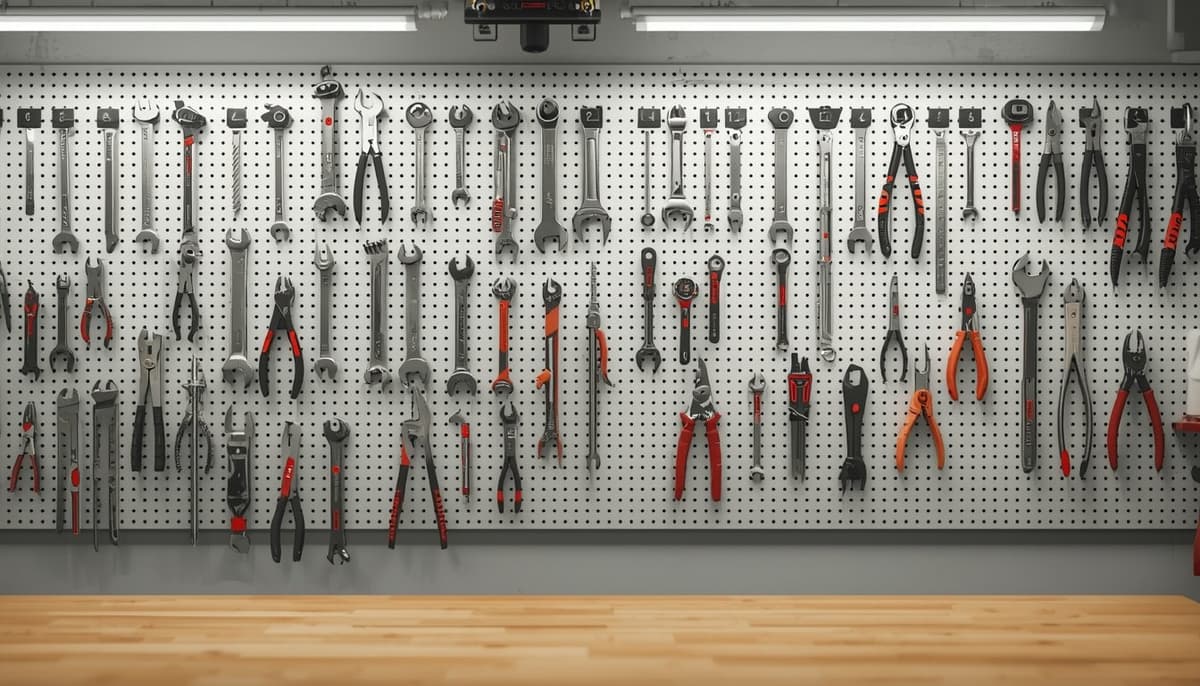
This is a 5S classic and one of the most effective visual management tools out there. A shadow board is a panel (usually plywood or pegboard) with tool outlines and hooks in the right spots.
You look at the board — you instantly see what's in place and what someone took. An empty wrench outline says: "the wrench is in use." No counting, no checking a list, no asking anyone. In manufacturing plants, a shadow board paired with digital tool tracking takes it further - you know not just that the wrench is missing, but who took it and when.
Building a shadow board for one workstation takes 2-3 hours. You need: a board, hooks, a marker or paint for outlines. Material cost: $50-100. Time saved from not searching: priceless.
The three-zone rule
Arrange tools by frequency of use:
Zone A (arm's reach) — tools used every day. Wrenches, screwdrivers, gauges. The operator reaches and grabs without standing up.
Zone B (2-3 steps away) — tools used a few times per week. Specialty wrenches, measuring instruments, changeover tools.
Zone C (storage, cabinet) — tools used once a month or less. Special-purpose tools, backups, seasonal items.
This hierarchy saves micro-time. A few seconds per reach. Multiply by dozens of reaches per day, across 250 working days — it adds up to hours.
Location labeling
Every cabinet, drawer, shelf, and hook needs a label. Not a fancy inscription — a simple, readable tag. "Cabinet A2, Shelf 3" on the cabinet and on the tool. The operator knows the torque wrench lives at A2-3. A new hire seeing the shop for the first time should find any tool in under a minute — on their own, without asking.
Step 3: Seiso - Shine
The third S isn't "clean up at the end of the shift." It's a fundamental mindset change — cleanliness as a form of inspection.
When you regularly clean a tool, you see it up close. You notice a cracked housing, a loose tip, an oil leak, a worn brush. Cleaning is the opportunity to catch a problem early, before it becomes a breakdown.
In Toyota factories, operators don't have janitors for their stations. They clean them themselves — not because the company is saving on cleaning staff, but because an operator who cleans their machine every day knows it best. They know how it should look, sound, smell. Any anomaly jumps out.
Daily cleaning routine
Five minutes at the end of the shift. That's all it takes. The operator:
- Returns all tools to their places (shadow board)
- Wipes down the workstation
- Visually inspects tools — does anything look different than usual
- Reports anomalies (if any)
Five minutes, every day, consistently. Companies that have implemented this routine report a 25-40% drop in tool failures in the first year. Not because cleaning fixes things — because early detection prevents escalation. This is especially visible in maintenance departments, where daily tool inspection during cleaning directly translates into faster breakdown response times.
Deep cleaning schedule
Once a week — thorough cleaning of the tool area. Once a month — review of the condition of all tools at each station. Once a quarter — full verification: condition, calibration, fitness for use.
This schedule sounds like bureaucracy. In practice, the weekly cleaning takes 20 minutes, the monthly review takes an hour, the quarterly check takes half a day. That's a small investment compared to the cost of a surprise tool failure in the middle of a production run.
Step 4: Seiketsu - Standardize
The first three S's can be implemented in a weekend. The fourth S determines whether they survive until the next weekend.
Standardization means turning good practices into binding standards. Not "Mike knows how it should be" — but "it's written down, photographed, and posted showing how it should be."
Reference photos
Take a photo of the workstation after implementing the first three S's. Print it. Hang it at the station. That's the standard — this is what the area should look like at the end of every shift.
A photo beats a description because it's unambiguous. "Tools put away neatly" is open to interpretation — for one person it means perfect order, for another it means "more or less in place." A photo leaves no room for doubt.
Control checklist
A simple list of items to check off at the end of each shift:
- All tools on the shadow board? Yes/No
- Workstation clean? Yes/No
- Anomalies noticed? If yes — what?
- Missing tools? If yes — which?
One sheet, 30 seconds to fill out. The shift supervisor reviews it at the end of the day. It's not about policing people — it's about catching problems before they grow.
Color coding and visual markers
Color communicates faster than text. In a standard 5S system:
- Green — correct placement, tool in working order
- Yellow — tool needs attention (calibration due soon, minor wear)
- Red — out of service, pulled from use, needs repair
An operator sees a yellow tag on a torque wrench and knows — time to send it for calibration. Sees red on a grinder — don't touch it, it's out of commission. No reading documents, no asking anyone.
Step 5: Shitsuke - Sustain
The fifth S is the hardest and the most important. The first four can be mandated by management. The fifth requires a change in habits.
Sustain isn't about fear of being caught. It's the moment when an operator puts a tool back in its place not because someone is watching, but because it's easier that way. When they know that tomorrow morning the wrench will be right where they left it. When they don't have to ask, search, or wait.
5S audits
Regular audits are the mechanism that keeps the system alive. Not punitive inspections — constructive reviews.
Daily (2 minutes) — the shift lead takes a quick look at the stations. Are the shadow boards complete? Are stations clean? Mental notes, only reacting to glaring issues.
Weekly (15 minutes) — a formal review with a checklist. Scoring 1-5 for each station. Results visible to everyone — on a board, not in an email nobody reads.
Monthly (1 hour) — a detailed audit with operators present. What's working? What's not? What should change? This isn't "punishment for a messy station" — it's a collaborative search for improvements.
Assigned ownership
Every station, every zone has an owner. Not "the department" — a specific person. Mike owns CNC station 3 and tool cabinet A2. Sarah owns the measurement area. Dave owns the secondary stockroom.
The zone owner isn't a guard — they're a steward. They maintain order, report problems, suggest improvements. They have the authority and the responsibility. They know it's their turf.
If putting a tool back takes longer than 60 seconds, the system is poorly designed. People won't follow procedures that cost them time. Every element of 5S must be faster than the alternative — otherwise it loses to "I'll just set it down here for a sec."
Common mistakes when implementing 5S
Mistake 1: The one-time blitz
The most common scenario: a company does a big cleanup over a weekend, paints the floors, hangs the boards, takes "before and after" photos for LinkedIn. Two months later, the shop looks the same as it did before.
5S isn't an event — it's a system. If you don't have a plan for sustaining it (steps 4 and 5), don't bother starting. The disappointment after a failed rollout is worse than never trying — because next time, nobody will believe in it.
Mistake 2: Top-down rollout without operator buy-in
A manager buys the boards, arranges the tools, sets the rules. Operators show up Monday morning and find a revolution nobody asked them about. Resistance guaranteed.
Operators need to co-create the system. They're the ones who know which tools they use most. They're the ones who know whether a shadow board in that spot makes sense or gets in the way. They're the ones who will (or won't) follow the system every day.
Mistake 3: Perfectionism from day one
"We'll do it perfectly or not at all." No. Do it well and improve. The first shadow board will be imperfect. The first tool arrangement — due for adjustment. That's normal. 5S is iterative — implement, observe, refine.
Companies that chase perfection from the start spend months planning and never implement. Companies that start with "good enough" have a working system in two weeks and spend years improving it.
Mistake 4: Skipping the fifth S
Sort, Set in Order, Shine — those are easy. Standardize — harder, but doable. Sustain? That's a culture change. And that's where most companies give up.
Without the fifth S, the first four have a shelf life of 2-3 months. Then entropy wins. People revert to old habits. Boards stop being updated. Checklists sit empty. And someone says: "We tried 5S. It doesn't work."
It works. But only with the fifth S.
How long implementation takes
A realistic timeline for a workshop with 10-15 stations and 200-400 tools:
Weeks 1-2: Sorting. Red tags, quarantine, decisions. Involves 2-3 people, 2-3 hours a day.
Weeks 3-4: Set in Order. Shadow boards, labels, layout. This is the most labor-intensive phase. You need materials (boards, hooks, labels) and time to physically set up each station. 4-6 hours a day, 2-3 people.
Week 5: Shine and Standardize. Deep cleaning, reference photos, checklists. 2 days of intensive work.
Weeks 6-12: Sustain. Audits, adjustments, building habits. This phase has no end date — but after 6 weeks of consistent audits, the system starts running on its own.
Total: 5-6 weeks of active implementation. Material cost: $1,000-2,500 (boards, labels, markers, paint). Time cost: 100-150 person-hours.
That's significant. But spread over six weeks — it's an hour or two per day. No company shuts down because of that.
Mike's shop - three months later
Let's go back to Mike and his torque wrench.
After implementing 5S, the shop looks like a different place. Shadow boards at every station. Color-coded labels on the cabinets. Reference photos posted above the workbenches.
Mike starts his Monday. He needs the 40-200 Nm torque wrench. He walks up to the tool board at CNC station 3. The wrench is hanging on its hook, between the socket wrench and the torque screwdriver. He grabs it, starts working.
Time spent searching: 8 seconds.
Not 22 minutes. 8 seconds.
The production manager calculated the savings after the first quarter post-implementation. Average time spent searching for tools per station dropped from 18 minutes a day to 3 minutes. Across 12 stations, that's 3 hours reclaimed every day. At $75 per hour per station — that's $225 a day. Over $56,000 a year.
For an investment of $2,200 and six weeks of effort.
But Mike says the biggest change isn't in the numbers. "Before, I started every day with frustration. Searching, asking, waiting. Now I start with work. I know where every tool is. I can focus on what I'm paid to do — machining, not running around the shop."
The 5S system isn't complicated. Five steps, simple rules, zero magic. All it demands is the decision to start — and the consistency to not quit after the first weekend.
Mike started with one station. His own. The rest of the crew joined in after two weeks, once they saw the difference. That's usually how 5S works — not by mandate from above, but by example from below.