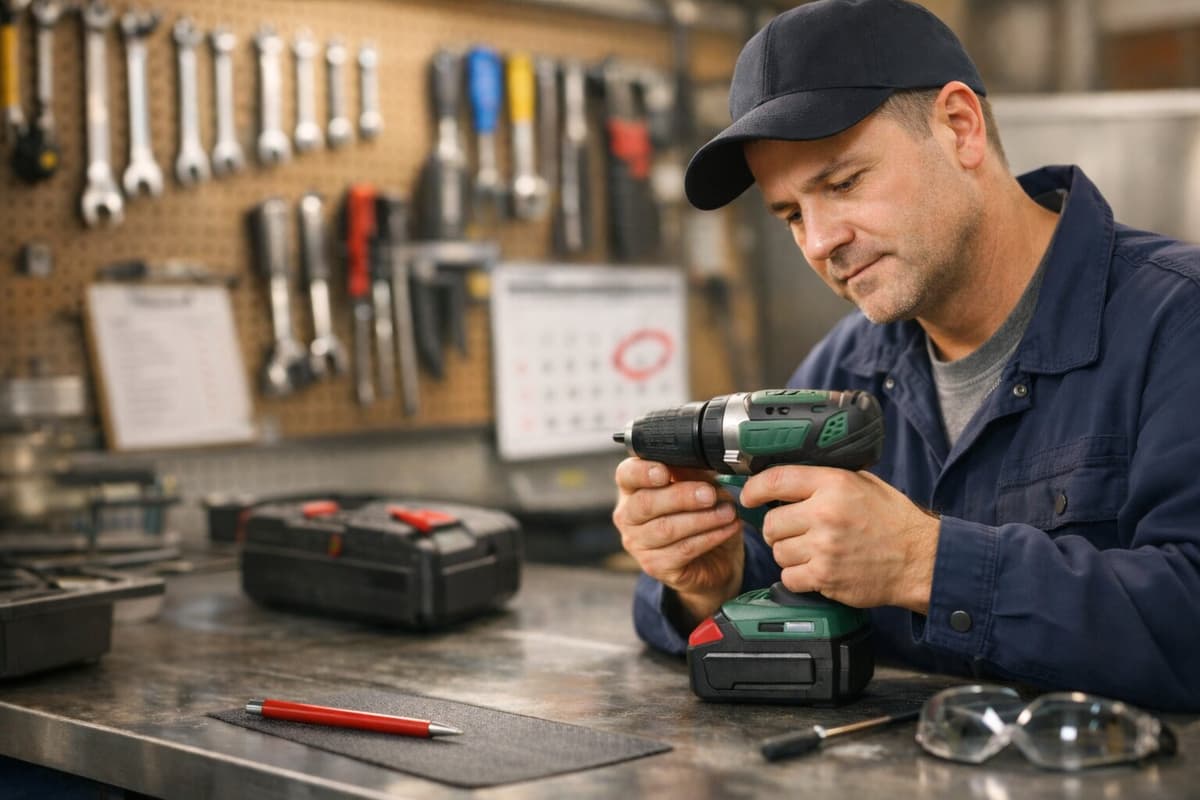
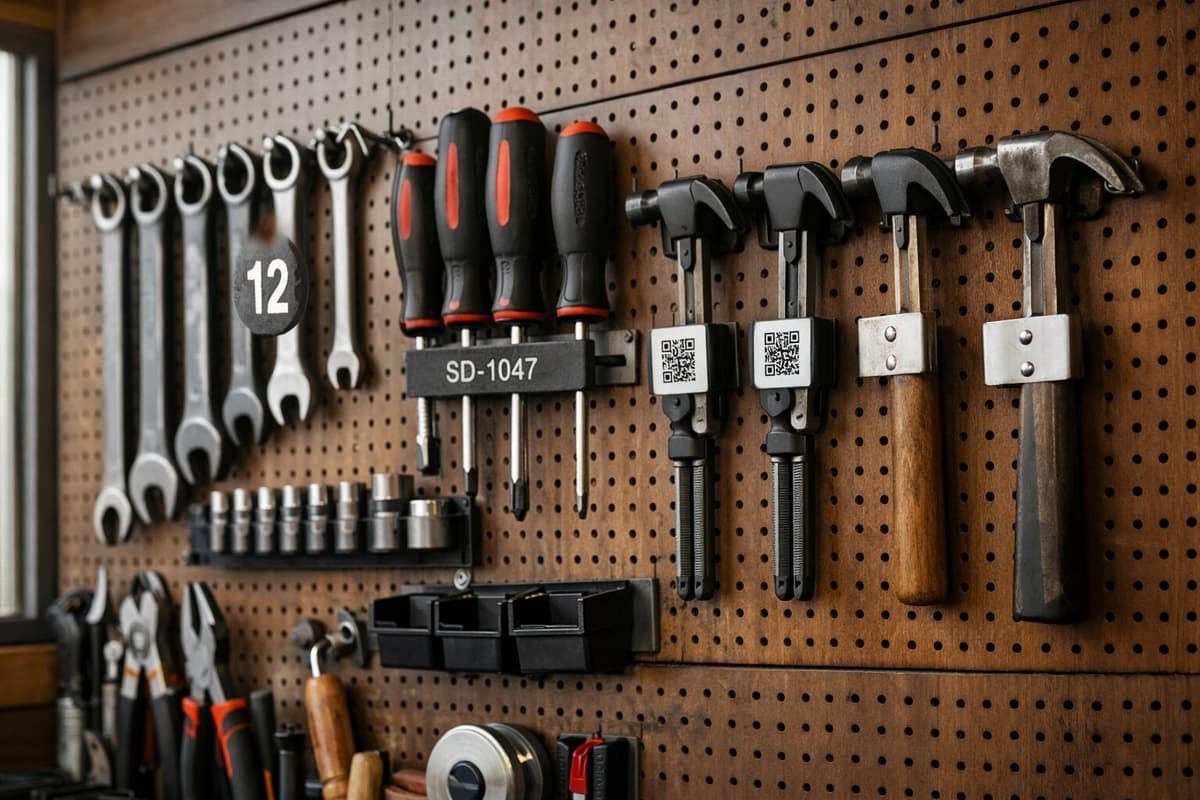
"I need to see your power tool inspection records." Six words that can shut down a construction company for an entire day.
Marcus runs a remodeling company in Denver. 60 power tools, 8 employees. When the OSHA inspector asked for documentation, Marcus pulled out a folder. The last inspection report was dated 14 months ago.
"And those drills on the job site? When were they tested?" Marcus didn't know. Because no document existed to tell him.
Marcus's problem wasn't that he skipped inspections. He did them — once a year, all at once. The problem was that he didn't know how often he should inspect, who is qualified to do it, and what exactly the documentation must include.
This article answers all three questions.
The regulatory landscape — why it's confusing
Let's start with why there's so much confusion.
OSHA has clear requirements that tools must be safe, but doesn't prescribe exact inspection intervals for portable power tools. 29 CFR 1926.302 covers power tool safety in construction. 29 CFR 1910.334 covers electrical safety-related work practices. NFPA 70E adds requirements for electrical equipment maintenance.
But none of them say "inspect your angle grinder every 6 months."
That's where the confusion starts. The obligation exists. The specifics don't.
OSHA's General Duty Clause (Section 5(a)(1)) — employers must maintain a workplace free from recognized hazards. 29 CFR 1926.302(a) — power tools must be maintained in a safe condition. 29 CFR 1910.334(a)(2) — portable cord-and-plug equipment must be visually inspected before each use. NFPA 70E 205.4 — regular inspection and testing of electrical equipment. Non-compliance penalties: up to $16,131 per serious violation.
In practice this means: you must inspect, but regulations don't tell you exactly how often. That's why the industry uses risk-based categories — similar to the European PN-88 standard approach — as best practice. OSHA inspectors won't ask for a specific norm number. They'll ask for records, schedules, and the qualifications of whoever did the testing.
Risk-based inspection categories
Without a mandated schedule, the industry standard is to categorize tools by operating conditions and set frequencies accordingly. This approach is widely accepted by safety professionals and OSHA inspectors.
Category I — occasional use in controlled environments
Power tools stored in dry rooms, used occasionally. Typical setting: workshop, office, warehouse.
Examples: a drill press in the shop used a few times a week, bench grinder, jigsaw for light work.
Inspection frequency: every 12 months.
Category II — frequent use in moderate conditions
Power tools used frequently in less favorable conditions. Typical setting: manufacturing floor, repair shop, busy workshop.
Examples: angle grinders on the production line, hammer drills in a service center, table saws in a woodshop.
Inspection frequency: every 6 months.
Category III — heavy use in harsh conditions
Power tools exposed to moisture, dust, vibration, extreme temperatures, or chemical exposure. Typical setting: construction site, mine, outdoor work, wet locations.
Examples: every power tool on a construction site, rotary hammers, concrete saws, demo tools.
Inspection frequency: monthly (basic safety check) and every 6 months (full electrical testing).
The category depends on working conditions, not the tool itself. The same Makita drill can be Category I (home workshop), II (factory floor), or III (construction site). If a tool rotates between job sites — it's Category III, even if it's currently sitting in the warehouse.
What an inspection covers
A power tool inspection isn't "check if it turns on." It's a specific set of measurements and visual checks.
Visual inspection
- Housing condition (cracks, mechanical damage)
- Power cord condition (insulation damage, kinks, abrasion)
- Plug condition (loose pins, damaged contacts)
- Switch operation (reliable engagement and disengagement)
- Guards and safety devices (completeness, secure mounting)
- Rating plate (legibility)
Electrical testing
- Insulation resistance — measured with a megohmmeter at 500V DC. Minimum acceptable: 1 MΩ for Class I tools, 2 MΩ for Class II.
- Ground continuity (Class I only) — resistance below 0.5 Ω.
- Leakage current — below 0.75 mA for Class I, below 0.25 mA for Class II.
Functional test
- Power-on without load
- Smooth operation check (no jerking, unusual vibration, or abnormal sounds)
- Emergency shutoff test (if applicable)
Class I — tools with metal housings and a grounding conductor (three-prong plug). Require grounding. Example: older drills with metal bodies. Class II — double-insulated tools, marked with the ◻ in ◻ symbol. No grounding required. Most modern power tools are Class II.
Who can perform inspections
This is the question many employers can't answer. And OSHA inspectors ask it.
Qualified persons
OSHA defines a "qualified person" as someone who has training and demonstrated skills to distinguish exposed live parts and determine nominal voltage. For electrical testing of power tools, this typically means:
- Licensed electricians with experience in testing and measurement
- Persons with specific training in portable appliance testing (PAT)
- NFPA 70E trained workers authorized for electrical equipment maintenance
There's no single national certification equivalent to a universal "power tool inspector" license. But the person must be demonstrably competent. Training records, certifications, and experience documentation matter.
Can your own employee do it?
Yes, if they're qualified. It doesn't have to be an outside company. Many maintenance electricians at manufacturing and construction firms have the necessary skills and training.
Cost for relevant training programs: $200–$500. Additional certifications (like NFPA 70E) may be required depending on your industry.
External service company
If you don't have qualified personnel — outsource it. Cost per tool inspection: $10–$25 (depending on region and volume). With 50 tools, that's $500–$1,250 per year.
Verify that the company provides inspection reports with the inspector's credentials and qualifications. Without that, the report has no value in an audit.
Inspection reports — what they must include
The report is the only proof an inspection happened. No report = no inspection in an auditor's eyes.
A proper inspection report contains:
- Date of inspection
- Tool identification — make, model, serial number, asset tag number
- Risk category (I, II, or III)
- Protection class (I or II)
- Scope of testing — what was checked
- Measurement results — insulation resistance (MΩ), ground continuity (Ω), leakage current (mA)
- Condition assessment — pass / fail / conditional pass
- Next inspection date
- Inspector data — name, qualifications, certification numbers
- Inspector signature
Bulk reports like "inspected 50 tools — all passed" without individual measurement results. OSHA won't accept them. Every tool needs its own entry with specific measurement values.
What OSHA inspectors look for
During an audit, an OSHA compliance officer checks:
- Are inspections current — compares last inspection date against the tool's risk category. A Category III tool with an 8-month-old inspection? Overdue.
- Who performed inspections — asks for the inspector's qualifications. Unqualified person = invalid inspection.
- Are reports complete — all 10 points listed above.
- Were failed tools removed from service — if a report says "fail," that tool can't be on the job site.
- Are tools clearly labeled — asset number, sticker with next inspection date.
Consequences
- Citation: $1,000–$16,131 per serious violation
- Order: immediate removal of uninspected tools from service
- Repeat violations: penalties can increase up to $161,323
- In case of injury: criminal liability if the tool lacked current inspection
Marcus from Denver got an order to pull 23 power tools from service. A week without tools across two job sites. The cost of that downtime dwarfed the cost of timely inspections. For more on what tool-related losses actually cost, read about the real cost of lost equipment.
How to manage this day-to-day
The theory is simple. The practice is that you have 60 tools in three categories, spread across four job sites, and you need to know which one is due for inspection next week.
Minimum solution: spreadsheet + stickers
Create a spreadsheet with columns: tool ID, name, category, last inspection date, next inspection date, location. Put a sticker on each tool with its next inspection date.
Problem: you have to manually check dates. Nobody does this consistently. That's why Marcus had overdue inspections — because a spreadsheet doesn't send reminders.
Better solution: a system with automatic alerts
A tool tracking system stores inspection dates for every tool and sends notifications in advance. One month before the deadline, one week before, one day before.
It doesn't replace the inspection — it replaces remembering the inspection. And forgetting is the problem, not the inspection itself.
The added benefit: history. After two years you have complete documentation for every tool. During an OSHA audit, you open a tool's record and everything is in one place — dates, results, reports, inspector name.
Frequently asked questions
Are hand tool inspections also mandatory? Formal inspections with reports — no. But employers are responsible for tool condition (OSHA General Duty Clause). Best practice: visual check before use, replace damaged tools. During an audit, showing that tools are in safe condition is sufficient.
Can I inspect my own tools? Visual inspection — yes. Electrical testing — only if you're qualified. If you're a sole proprietor with the right training, you can test your own tools.
What about cordless/battery tools? Battery tools (below 50V DC) don't require insulation resistance or ground continuity testing. They still require visual inspection and functional testing. Risk categories still apply for scheduling.
How long do I need to keep inspection records? For the entire service life of the tool. OSHA inspectors can request historical inspection records going back several years.
The tool is brand new — do I need to inspect it right away? Not immediately. A new tool has a manufacturer's warranty and conformity declaration. First inspection is due per its risk category, counted from the date it enters service.
Do your power tools have current inspections with proper documentation? If you need more than 3 seconds to answer — you already know.
If you want automatic reminders for inspection deadlines and a complete testing history for every tool — check out Toolero. 14 days free, no credit card required.