Wednesday, 6:00 AM, a metal fabrication plant outside Detroit. The morning shift clocks in. Operators walk over to the tool cabinet. Three of them need the same torque wrench. There's only one in the cabinet.
Shift supervisor Dave calls the stockroom. "We had three torque wrenches." The stockroom clerk checks the logbook. "One's with Mike from the night shift, the other should be at station 7." It's not at station 7. Mike from the night shift isn't picking up — he's asleep.
Two workstations are idle. The cost of one hour of downtime on that line — $600. The wrench turned up an hour and a half later in the break room. Someone left it there "for a minute" and forgot.
Loss: $900. For a tool worth $200.
Why the production floor isn't a construction site
On a construction site, tools disappear slowly — one here, one there. It hurts over a year, but on any given day it doesn't block work.
On the production floor, it's different. A missing tool means an idle workstation. An idle workstation means a stopped line. A stopped line means real losses — measured in hundreds or thousands of dollars per hour.
The average cost of one hour of downtime in a manufacturing plant ranges from $400 to $1,500, depending on the industry. One hour spent searching for a tool costs more than a full year's subscription to a tracking system.
Then there's the shift factor. Three shifts, three crews, the same tools. Who had them on the night shift? Who left them at a workstation? Who took them to the repair shop? Without a system, nobody can keep track. The maintenance department is usually hit the hardest, since their tools are in constant motion across shifts.
Three ways plants lose money on tools
Downtime from searching
Lean manufacturing studies show that operators in plants without a tracking system waste an average of 15–25 minutes per day searching for tools. With 50 operators, that's over 12 hours lost every single day. Multiply that by 250 working days and the average labor rate.
Dave from our Detroit-area plant calculated this after implementing a system. It came out to $85,000 per year — just the time spent searching, not counting production line downtime.
Duplicate purchases
"The wrench is gone — buy a new one." This decision gets made in manufacturing plants several times a week. Nobody checks whether the tool is actually lost or just on another shift. Nobody verifies, because there's nowhere to check.
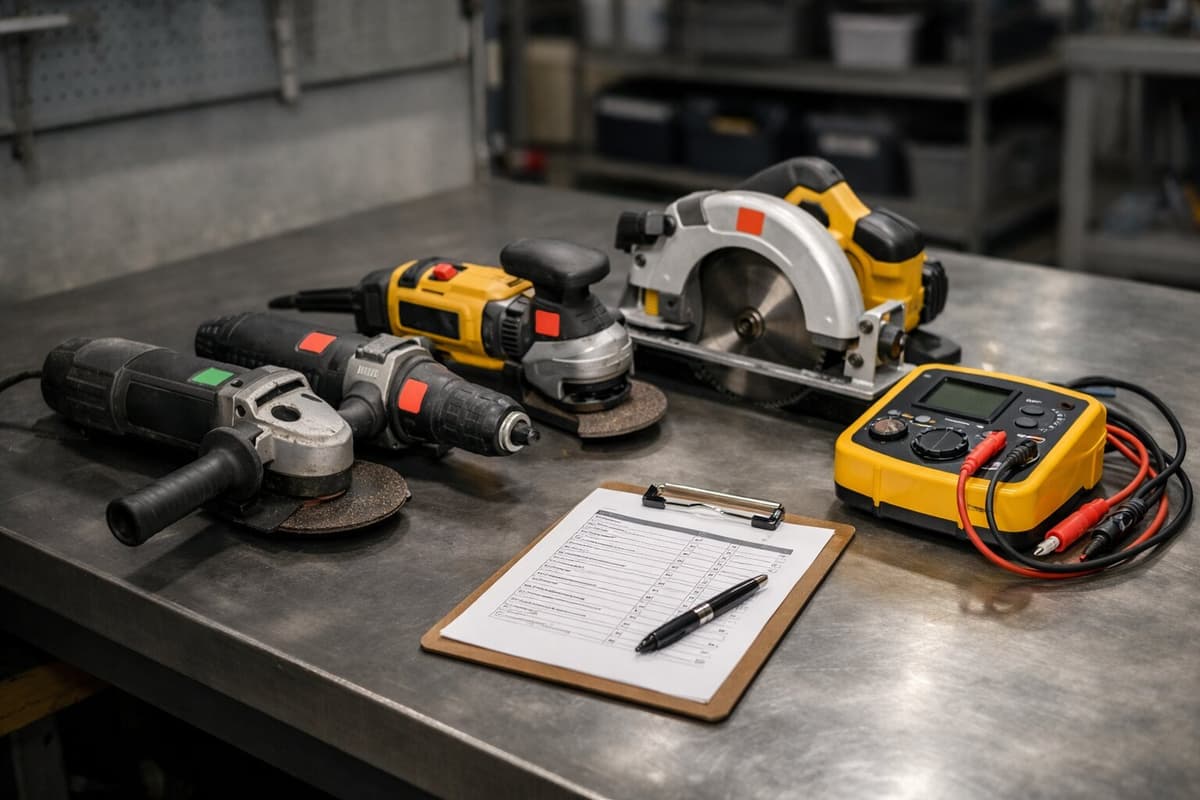
After a year, the stockroom is overflowing. Three sets of socket wrenches instead of one. Five angle grinders instead of three. Eight SDS drill bits instead of four. Each bought because "we didn't have one" — and they didn't have one because nobody knew where the existing ones were.
Damage without accountability
A tool passes through three shifts a day. It comes back damaged. Who broke it — the morning, afternoon, or night shift? Nobody knows, because nobody checked its condition at handoff. Without a proper tool handover protocol, there's no way to establish accountability.
The result: tools break down faster than they should. Operators don't report minor damage — why bother, since no one can determine who's responsible. Minor damage turns into a breakdown. A breakdown means replacement instead of repair.
5S and tool tracking
If your plant uses or is implementing the 5S method in your tool room, tool tracking is a natural part of the third S — Seiso (systematic cleaning/organization). Shadow boards, marked locations, visual controls — all of these require knowing what tools you have and where they should be.
But a shadow board without digital tracking has its limits. You see an empty spot on the board — a wrench is missing. But you don't know who took it, when, or to which station. You shout across the floor: "Who has wrench 17?" No answer.
Shadow board + QR code solves this completely. The empty spot on the board says "missing." A code scan says "wrench 17, checked out by operator Johnson, station 4, 45 minutes ago." You walk to station 4, the wrench is sitting next to the machine. The whole thing takes one minute instead of twenty.
Place a QR code at each spot on the tool board. The operator scans the code and confirms checkout. On return — scans again. The shadow board becomes digital, with a full history, and zero extra effort.
How to implement tracking without stopping production
The biggest fear among production managers: "implementing anything new means downtime, training, confusion." It doesn't have to.
Step 1: Inventory during a planned shutdown
Use a scheduled shutdown — a maintenance weekend, a holiday break, a machine overhaul. Gather all tools, catalog them, photograph them, assign numbers. One day is enough for a plant with 200–400 tool items.
Don't try doing this during production. Tools need to be in one place, and operators can't work and hand in equipment for counting at the same time.
Step 2: Labeling and entering into the system
Print QR codes — laminated, resistant to oil and coolant. Stick one on every tool. Enter the data into the system. Assign tools to workstations, shifts, and locations.
This step can be spread over a week — doing one section of the floor per day, during shift breaks.
Step 3: Pilot on one shift
Don't launch on all three shifts at once. Pick one — ideally the day shift, where you have the easiest contact with operators. Let that shift test the system for two weeks. Collect feedback, fix what needs fixing.
The pilot operators will become ambassadors for the rest. "We're already using it, it's easier" works better than a mandate from management.
Step 4: Full rollout
After the pilot, expand to the remaining shifts. Training? 10 minutes during the shift briefing. Show them: scan the QR, tap "check out," tap "return." If someone can unlock a phone — they can use the system.
Shift handoff — no more "I don't know who had it"
The biggest pain point in shift-based plants: tool handoff between shifts. The morning shift ends, the afternoon shift starts. Who hands off tools to whom? How?
Without a system, it looks like this: an operator sets tools down at the station and goes home. The next person shows up and grabs whatever's there. If something's missing — they search, call, wait.
With a system, the outgoing shift "closes out" their tools with a single scan. The system shows: all returned, one missing (wrench TW-012, last seen at station 6). The incoming shift knows immediately — look for the wrench at station 6, everything else is in place.
This isn't theory. A metal machining shop in Ohio implemented this model and cut shift handoff time from 25 to 5 minutes. With three shifts a day, that's an hour recovered every single day.
Results after implementation — the Detroit-area plant
Let's come back to Dave and his torque wrench.
After implementing a QR-based tracking system, the plant recorded concrete changes in the first quarter:
- Time spent searching for tools: down from 20 minutes to 2 minutes per operator per day
- Downtime due to missing tools: from 4–5 per week to 1–2 per month
- Duplicate purchases: zero (previously $500–$750 per month)
- Unattributed damage: down 70% (operators started reporting issues because the system documents who had the tool)
Implementation cost: $700 (labels, inventory time, annual subscription). Savings in the first year: an estimated $45,000 (downtime, purchases, search time). Return on investment: under 1 week.
Dave says the biggest change wasn't the money. "I stopped starting every day putting out fires. I know where every tool is, I know who has it, I know when it needs servicing. I can focus on production instead of hunting for wrenches."
Order on the production floor
Toolero works on any phone — operators scan a QR and log a checkout in 3 seconds. Free for 14 days.
Where to start on Monday
You don't have to wait for a planned shutdown. Start with one thing: count how many times this week someone spent more than 5 minutes looking for a tool. Write down every instance — who was searching, what for, how long it took, whether they found it.
After a week, add it up. Multiply by 50 weeks in a year. That's your annual loss on searching alone. Not counting downtime, not counting duplicate purchases, not counting damage.
That number is enough to make the decision. It was for Dave.