Thursday, 2:20 PM, a packaging plant outside Chicago. The packaging line goes down. A bearing failure in the main drive. Standard replacement - mechanic Jake does this every quarter. He needs a bearing puller, a torque wrench, and a socket set.
The puller is there. The torque wrench - cabinet is empty. The socket set - incomplete, three sizes missing.
Jake heads to the stockroom. Locked - the stockroom attendant is on lunch break. He calls the maintenance supervisor. "Check with Steve, I think he had it yesterday." Steve is on the other side of the plant. The wrench is sitting on his workbench, buried under a stack of paperwork. Jake finally found the missing sockets in a drawer near a CNC station - somebody "borrowed" them and never returned them.
Time from breakdown to start of repair: 47 minutes. The repair itself: 25 minutes. He spent nearly twice as long looking for tools as he did actually fixing the machine.
Cost of packaging line downtime: $800 per hour. Loss from searching for tools: ~$625. From a single incident.
Why Maintenance Has the Hardest Job
The maintenance department is unique. Tools don't sit quietly in storage - they're in constant motion. A mechanic grabs a set for a breakdown, comes back, puts it on his bench. An electrician borrows a meter, walks to another part of the plant, leaves it by an electrical panel.
Add the time pressure. When the line is down, nobody's thinking about logging a tool checkout in a notebook. Every minute counts. The mechanic runs with a wrench, not with a form.
And then there's shift work. The day shift has its crew, the afternoon shift has its crew, and the night shift is often a one-person operation. Tools are supposed to be handed off between shifts - but in practice, they end up wherever the last user left them.
According to a survey of 120 maintenance managers in the manufacturing sector, 62% identified "searching for tools" as one of the top three time wastes in their department. On average, a maintenance technician loses 35 minutes per day locating the tools and parts they need.
MTTR Increases Because of Tools, Not Skills
MTTR - Mean Time To Repair - is the key metric in maintenance. The lower it is, the faster you get back to production after a breakdown.
Most plants try to reduce MTTR with training, better spare parts, repair procedures. That's important. But they overlook the simplest factor - the time it takes to prepare for the repair.
Jake from the packaging plant has an MTTR of 25 minutes for a bearing replacement. That's a good result. But from the moment the breakdown is reported to the moment he starts the repair, an additional 47 minutes passes while he hunts for tools. The real response time is 72 minutes, not 25.
Cut the search time from 47 to 5 minutes, and MTTR effectively drops by 60%. No training, no new procedures, no investment in parts. Just knowing where the tools are.
Emergency Kits - The First Step
The simplest way to improve response time: dedicated tool kits for the most common breakdowns.
Analyze your breakdown history from the last 12 months. List the 5-10 most frequent repair types. For each one, identify the tools needed. Put together a complete set in a lockable case and label it: "Emergency Kit - Bearing Replacement," "Emergency Kit - Belt Drives."
The kit hangs on the wall next to the production line. Breakdown happens - the mechanic grabs the kit and has everything. Zero searching, zero phone calls, zero walking around the plant floor.
Check emergency kits once a week. It takes 5 minutes - open the case, verify everything's there. If someone took a tool and didn't put it back, you know right away - not during the next breakdown.
Cost of assembling the kits: a few hours of a technician's time. Savings: dozens of minutes per breakdown. With two breakdowns per week - hours recovered every month.
Personal Tools vs. Shared Tools
In a maintenance department, this distinction is critical but rarely formalized.
Personal tools are the ones a mechanic uses daily: socket set, screwdrivers, pliers, multimeter. Each technician has their own set, is responsible for it through a formal handover protocol, and either carries it or keeps it in their locker.
Shared tools are the specialized and expensive items: pullers, torque wrenches, thermal imaging cameras, vibration analyzers. Buying a full set for every technician doesn't make economic sense.
The problem lies with shared tools. Who had it last? Where is it? Is it in working order? Without a tracking system, these questions come up at every breakdown.
Solution: a maintenance tool board with a QR code at each slot. A technician takes the puller - scans the QR - the system logs who, when, and for which machine. Returns it - scans again. The next technician opens their phone and sees: puller is on the board, torque wrench is with Jake at Line 3.
The Maintenance Stockroom - Order That Sticks
A maintenance stockroom is typically metal cabinets with hundreds of items. Wrenches, sockets, pullers, measuring instruments, consumables. Without a system, it looks like this: three cabinets, doors hanging open, half the tools not in their places, the rest "somewhere on the floor."
The Checkout Zone
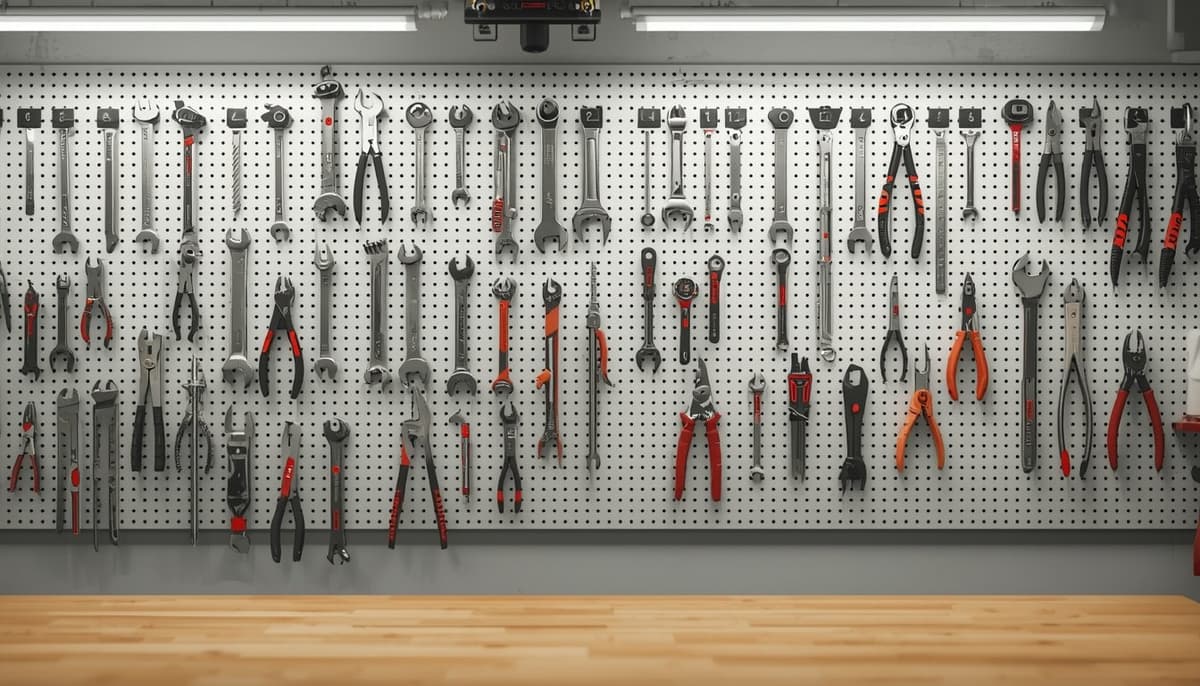
Separate shared tools from the spare parts inventory. Tools get their own cabinet with labeled slots - the principle that "every tool has a home" straight from the 5S method. Each slot = one tool = one QR code.
A mechanic walks up, scans the code, takes the tool. The system knows Jake has the torque wrench since 2:23 PM. Jake returns it, puts it back, scans. The system logs the return.
Shift Access
On the day shift, there's a maintenance supervisor, a stockroom attendant, oversight. On the night shift - often just one mechanic for the entire plant. They need access to tools without calling anyone.
A QR-based system handles this naturally. The night shift mechanic scans with their phone and takes what they need. In the morning, the supervisor sees in the system what was checked out overnight, what came back, and what didn't.
No more "someone on nights took my wrench and never returned it." The system shows who, when, and where.
Calibration and Tool Inspections
Maintenance tools require not just tracking, but regular inspections. A torque wrench without calibration is a dangerous tool - the torque reading is wrong, and the bearing either comes loose or gets overtightened.
Torque wrenches: calibration every 12 months or 5,000 uses. Electrical meters: calibration every 12 months. Thermal imaging cameras: calibration every 24 months. Measuring instruments: per manufacturer specifications. No calibration = no guarantee of accurate readings = risk of equipment failure.
A tracking system with a maintenance schedule monitors deadlines automatically. One month before a torque wrench needs calibration - an alert goes to the maintenance manager. Without it? The deadline passes silently, nobody remembers, and the tool operates with unreliable accuracy.
What a Missing System Costs in Maintenance - The Math
Let's run the numbers for a plant with a 30-person maintenance department (three shifts of 10).
Time searching for tools: 35 minutes/day x 30 people x 250 days = 4,375 hours per year. At $35/hour = $153,125.
Downtime from missing tools: 2 incidents/week x 30 minutes x 50 weeks x downtime cost of $500/hour = $25,000.
Duplicate purchases: Estimated at 5-10% of the tool budget. With a budget of $20,000/year = $1,000-2,000.
Annual total: ~$180,000. Cost of a tracking system: ~$1,500 per year. ROI: less than a week.
These numbers aren't theoretical. The packaging plant outside Chicago, the one with Jake and the bearing, calculated them after implementation. "I didn't believe those figures," said the maintenance manager. "But when I saw 35 minutes a day turn into 5, the math added up."
Bring order to your maintenance tools
Toolero works on a phone - a technician scans a QR code and logs a checkout in 3 seconds. Automatic calibration alerts. 14-day free trial.
What the Chicago Plant Implemented
Three steps, spread over one month.
Week 1: Full tool inventory during a weekend shutdown. Result: 340 items. They'd expected 280. The 60 "extra" tools were duplicates bought because someone couldn't find what was sitting in somebody else's drawer. A pattern that's common across production floor tool tracking in general.
Weeks 2-3: QR codes on shared tools (120 items). Tool board with labeled slots. Emergency kits for the 5 most common repairs.
Week 4: Training - 10 minutes at the start of each shift. "You take it - you scan it. You return it - you scan it." Three taps, three seconds.
Results after one quarter: breakdown response time dropped 40%. Duplicate tool purchases: zero. Missing shared tools: from 5-6 per month to zero.
Jake, the mechanic from the bearing story, summed it up best: "I used to run around the floor calling people asking who had the wrench. Now I open the app, see that the wrench is on the board, and walk straight there. I fix machines instead of searching for tools. That's what I'm here for."