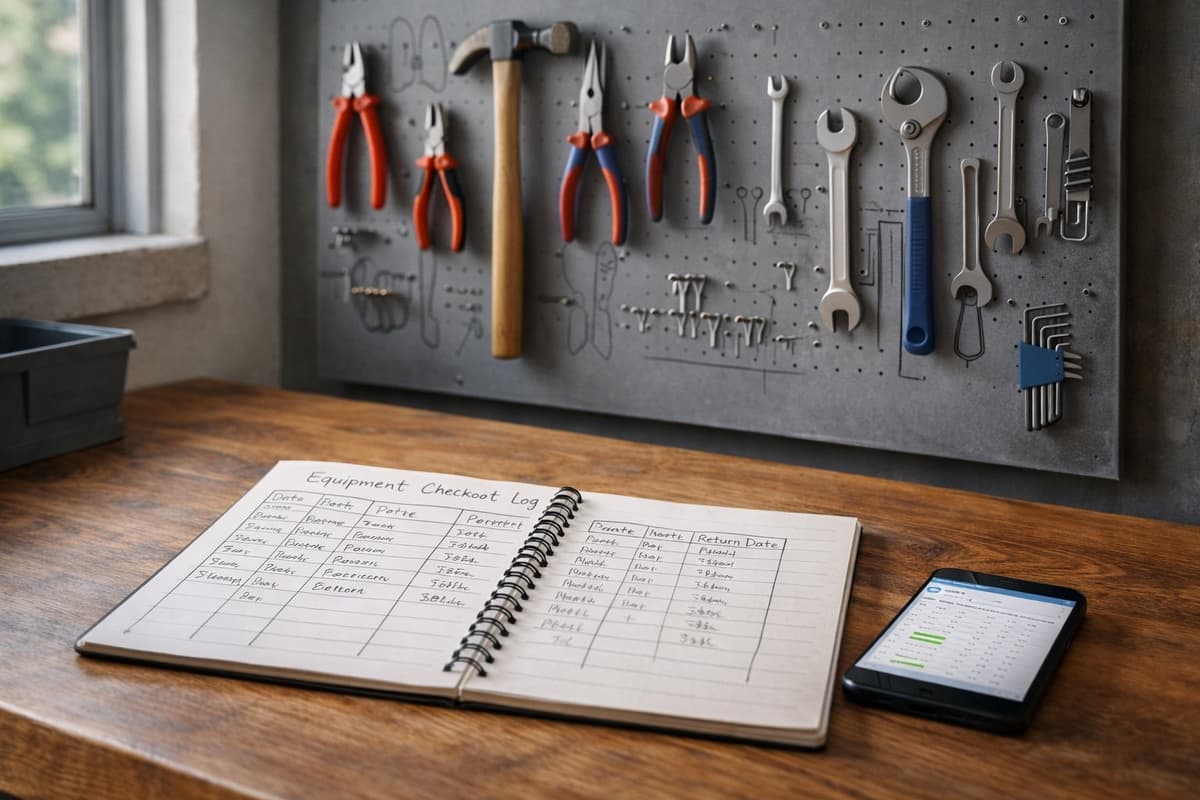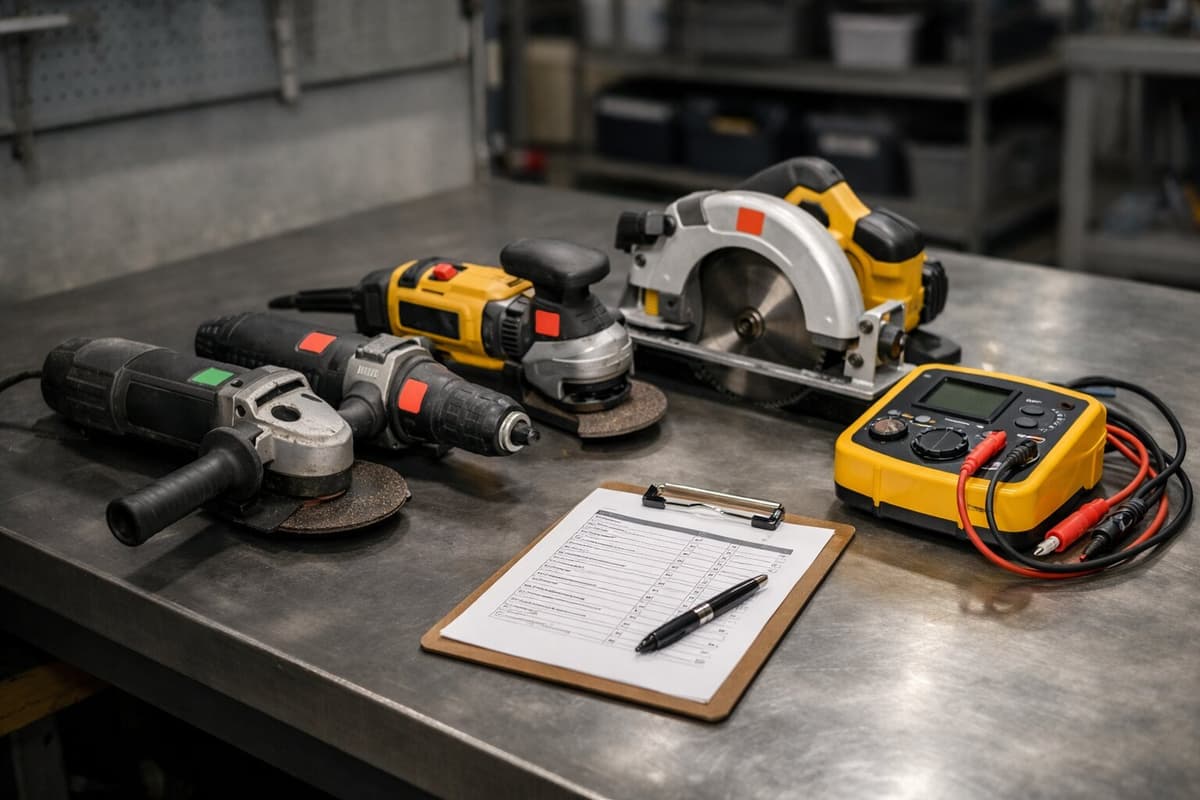
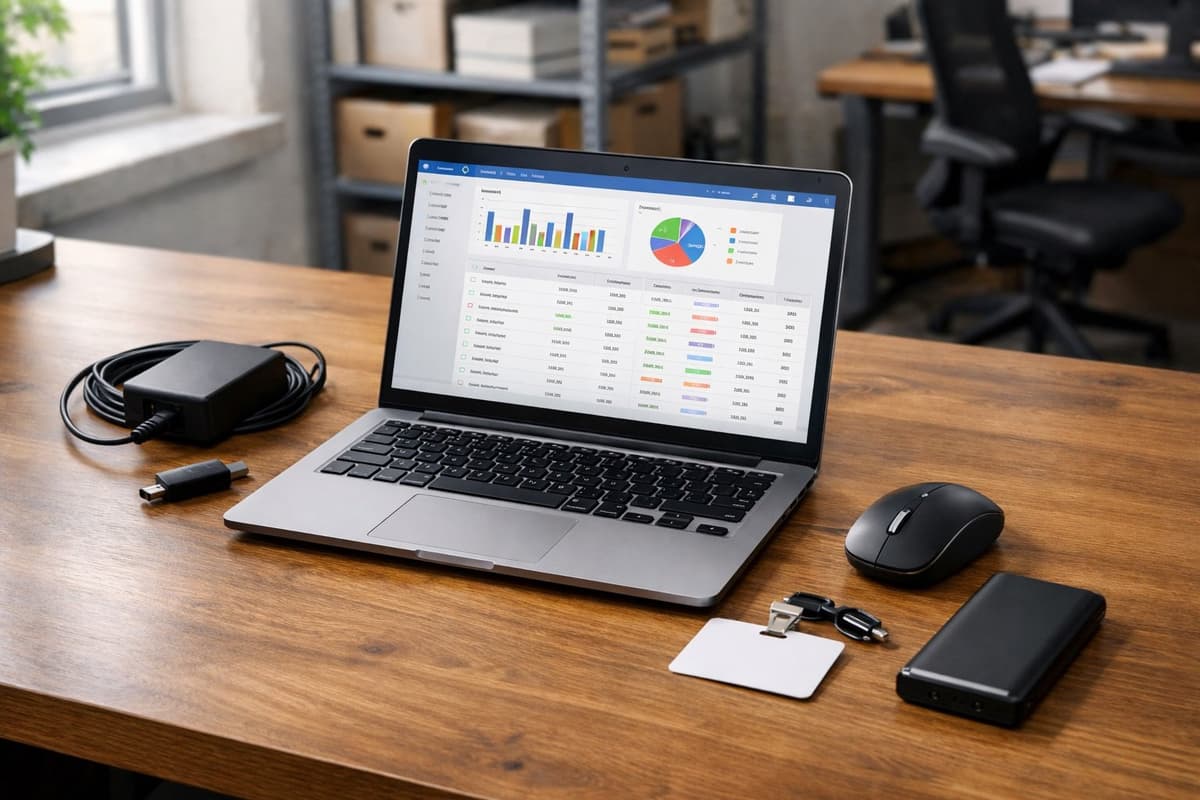
There's no minimum dollar amount that makes equipment worth tracking. The IRS de minimis safe harbor threshold of $2,500 exists for tax purposes — it has nothing to do with operational control. If a piece of equipment can disappear, it belongs in your tracking system. Doesn't matter if it cost $40 or $4,000.
Where the question comes from
Google "equipment tracking minimum value" and you'll get results about fixed assets, capitalization thresholds, and depreciation schedules. Fair enough — from an accounting perspective, there is a line. Under the IRS de minimis safe harbor election (IRS Publication 946), businesses can expense assets costing up to $2,500 per item instead of capitalizing and depreciating them. If your company has audited financial statements under GAAP, that threshold goes up to $5,000.
That's clean. That's organized. And it's completely beside the point.
Because the question you should actually be asking isn't "at what dollar amount do I need to track equipment?" It's "how much am I losing on equipment I don't track?"
Accounting cares about asset values. Operations cares about where your stuff is, who has it, and whether it's coming back. Two different worlds. You can have perfectly maintained depreciation schedules on a $9,000 server while simultaneously having no idea that forty laptop chargers at $70 each vanished over the past twelve months.
The capitalization threshold exists to simplify your books. Not to simplify how you run your business. But plenty of owners treat it exactly that way — as a signal that anything under $2,500 is "small stuff not worth worrying about."
That's the trap. The $2,500 line tricks you into thinking cheap equipment isn't worth tracking. But cheap equipment is where the biggest losses hide.
Low-value equipment disappears more often — and nobody goes looking
A $3,500 laser level is one item. It lives in a Pelican case with a label on it. The site super knows about it, the warehouse manager knows about it, the tech who uses it knows about it. If it vanishes, there's going to be a conversation.
But a $70 laptop charger? A $45 USB-C adapter? A $100 blood pressure monitor at a clinic? Nobody sounds the alarm when one goes missing. The problem is, it's never just one. It's five, ten, twenty — over a year, quietly, without drama.
Here are real scenarios from companies that finally counted the damage:
IT services company, Austin, TX — 80 employees. Over one year, they "lost" 34 laptop chargers ($70 each), 12 USB-C adapters ($45 each), 8 wireless mice ($40 each), and 3 headsets with mics ($130 each). Total: over $3,650. On equipment nobody tracked because "it's just accessories." The IT department auto-ordered replacements. Nobody asked where the old ones went.
Medical practice, Denver, CO — 25 staff. Three blood pressure monitors ($100 each), two pulse oximeters ($250 each), one otoscope ($350), four no-touch thermometers ($80 each). Total: $1,470. Over two years, that's nearly $3,000 — enough to buy a portable ultrasound unit. Most of the equipment was probably sitting in exam room drawers used by rotating physicians. Nobody assigned it, so nobody watched it.
Logistics company, Columbus, OH — 60 employees. Handheld barcode scanners at $400 each. Four disappeared in a year. Nobody knew when, nobody knew who had them last. That's $1,600 right there. Add 15 power banks at $35 each and 8 flashlights at $30 each — gear drivers received "for the truck" with zero documentation. Another $765.
Media production house, Brooklyn, NY — 15 people. Two camera lenses at $900 each, a lavalier mic at $300, five memory cards at $60 each. Total: $2,400. Equipment floated between shoots, and the only "system" was a group chat where someone typed "grabbing the 50mm." Three months later, nobody remembered who posted that.
Fifty lost drill bits at $15 each costs the same as one lost laser level at $750.
The difference? Someone goes looking for the laser. Nobody goes looking for the bits.
Equipment under $200 vanishes without a trace because nobody reports a single loss. It takes a proper inventory audit to reveal the full scale — and the numbers are always a shock. Companies routinely discover that 15-25% of their low-value equipment is gone. The stuff that "wasn't worth tracking."
When's the last time you checked how many adapters, chargers, and cables your company bought this year — and how many are still in use?
Tracking isn't accounting — it's operational control
A lot of business owners equate equipment tracking with tax obligations. If the IRS doesn't require you to capitalize and depreciate a $1,800 laptop — why bother putting it in any kind of register?
Because operational tracking answers different questions than accounting does.
Accounting asks: what's the value of this asset and how do I depreciate it? Operations asks: where is that laptop, who has it, when was the software last updated, and did the employee who quit on Friday return their gear?
A manufacturing shop in Detroit with 40 people has injection molds, measurement gauges, and assembly jigs on the floor. None of them hit the $2,500 capitalization threshold. Most fall in the $300-$1,500 range. But without them, production stops. When a $900 measurement gauge disappears from the shop floor, the issue isn't its book value. It's that the QC line can't run.
A media production company in LA with 15 people has cameras, lenses, mics, gimbals, LED panels. The $5,000 camera body is in the asset register. But the $800 gimbal? The $300 lav mic? The $60 memory card? "That's small stuff." Until the crew drives to a shoot and the gimbal is missing. Or the mic. Or three memory cards.
Operational tracking means knowing what you own, where it is, and who's responsible for it.
You don't have to depreciate it. You have to manage it.
Take an office with three conference rooms. A $1,000 projector, three conference camera kits at $750 each, two tablets for room booking at $500 each. Nothing crosses the capitalization threshold. But when Monday morning rolls around and the projector is "somewhere," the camera in Room B is dead, and nobody's seen the tablet in two weeks — you've got a real operational problem. Client meeting in an hour, and you're running through the office instead of prepping.
Book value is one thing. Operational value is another. Those two sentences should be posted in every office right next to the depreciation schedule.
The cost of not tracking grows with every new hire
A solo operation doesn't have a tracking problem. The owner knows what they have because they use it themselves. But the moment you hit five people, chaos starts creeping in.
At 10 employees — everyone has "their" equipment, but nobody documented who got what. Someone leaves, their laptop "somehow" stays at their place. The new hire gets brand new gear instead of recovered equipment.
At 30 employees — IT buys equipment in bulk but can't say how many monitors are in the stockroom, how many are on desks, and how many are at people's homes on remote days. Ordering "just in case" becomes standard practice.
At 100 employees — the company has equipment spread across three offices, on the production floor, in company vehicles, and at home with remote workers. Nobody can say how many projectors the company owns. Three? Five? There used to be seven.
Scale changes everything.
One field services company in Charlotte with 45 employees calculated that they spent $8,500 a year "replacing" equipment that hadn't worn out — it had just disappeared. Laptops, tablets, diagnostic tools, power banks, service bags. Nobody was stealing. Things just drifted, changed hands, ended up in drawers. Without a system, nobody realized the same multimeter had been purchased three times because the first two were "somewhere."
There's also a hidden cost nobody talks about: time. Time searching, time ordering, time waiting for delivery. An employee who spends 20 minutes looking for a laptop charger isn't doing their actual job. Multiply that by 50 employees and 250 working days. Even if everyone wastes only 5 minutes a day, that's over 1,000 hours a year. At $30 an hour, that's $30,000. Just on searching.
How many times has your company bought something it already owned — but couldn't find?
Ask five random employees what company equipment they currently have. Compare their answers to whatever records you keep. If the lists match — you have a system. If they don't — you have a problem that grows with every new hire.
Every new person on the payroll is another risk. Not because people steal — but because without a system, nobody knows what belongs to whom. And "I don't know" quickly turns into "it's gone."
There's also the offboarding question — the departing employee. In a company with no tracking, nobody knows exactly what they should return. The laptop? Sure, everyone remembers that. But the docking station? The second monitor? The key to the supply closet? The access badge? The company power bank? An equipment list assigned to each person is the only way to recover everything when someone leaves — not just the things you happen to remember.
"But it's not worth it for cheap stuff"
I hear this all the time. "I'm not going to log a $15 cable into a system." And I get the reaction. Equipment tracking conjures images of bureaucracy — forms, spreadsheets, hours spent entering serial numbers.
But modern tracking doesn't look like that.
Scan a QR code with your phone. Three seconds. Done. Employee grabs a charger from the supply closet, scans the code, the system records who, what, when. Returns it — scans again. No Excel, no binder, no forms.
Is that worth it for a single $15 cable? No. But nobody loses just one cable. Companies lose dozens of items a year. And the real question isn't "is it worth tracking a $15 cable?" It's "is it worth knowing that 40 cables totaling $600 disappeared this quarter?" You won't see that without tracking. Not in your books, not in your head.
If the cost of lost equipment exceeds the cost of tracking it, the math is settled. And with today's tools, the cost of tracking is close to zero.
The "not worth it" argument only holds when tracking requires serious effort. It used to. It doesn't anymore. And that changes the entire calculation.
The $2,500 threshold answers the wrong question
Equipment tracking doesn't start at a dollar amount. It starts at the moment you can't look at a purchase order and say where the equipment you bought actually is.
For a solo operation, that moment may never come. For a company with 10 people, it arrives faster than you think. For a company with 50 — it probably passed a long time ago.
The $2,500 IRS threshold is a tax answer to an operational question. And the operational question is simpler: do you know what you have?
If you don't — the dollar amount doesn't matter. You're losing equipment whether it cost $40 or $4,000. The difference is that you'll notice the $4,000 loss. The $40 loss multiplied by a hundred? You won't.
And it's that second number that does the real damage.
If you want to know where to start, check out how to choose an equipment tracking system that fits your business — regardless of industry or size.
If you're looking for an easy way to track company equipment, Toolero works with any type of gear — from laptops to laser levels. 14 days free, no credit card required.