A typical American rental shop that operates only Monday through Friday from 8 a.m. to 5 p.m. is leaving 30–40% of potential revenue on the table. The customer who wants to pick up equipment Saturday at 7 a.m. either calls a competitor or gives up entirely.
That sounds like a truism, but the consequence is bigger than you'd think: over the next three years in the American small-shop rental industry, 24/7 self-service with smart lockers will stop being an experiment and become a competitive standard.
That's my position. There are six arguments for it — and along with each, the legitimate counterargument that shouldn't be dismissed.
Argument 1: Self-service already solved this in adjacent industries
Amazon Locker reshaped e-commerce delivery in five years — from 2014, when the first lockers rolled out, to 2019 when "drop in a locker" became the default for many urban deliveries. Today, sending a package to a residential address is increasingly the minority option in dense areas.
Bike shares (Citi Bike, Lime, Spin) — operate exclusively self-service via app. Carshare (Zipcar, Turo, Getaround) — same model. Sports equipment rental at hotels and resorts — increasingly kiosk-based.
The equipment rental industry is lagging these trends by 5–7 years. Not because it's structurally different, but because no one has built the infrastructure and validated the model at small scale yet. The first independent shops to do it will gain a first-mover advantage in their local markets.
Argument 2: Locker economics already pencil out
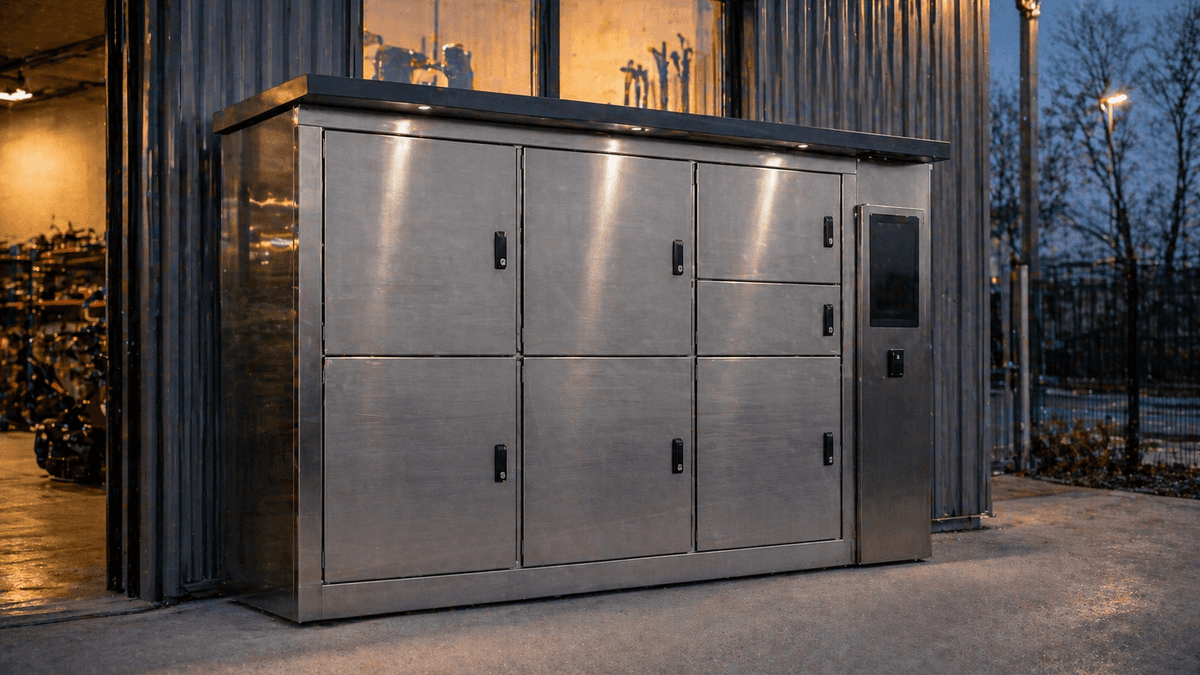
A smart locker bay with 8 compartments, electronic locks, a camera, and a touchscreen costs $8,000–$14,000 (purchase) or $200–$450 monthly (lease/SaaS).
In a typical rental yard with $200,000 annual revenue, hiring a part-time staffer for evening shifts (5 p.m.–10 p.m.) costs around $1,800–$2,400 monthly loaded. A smart locker replacing that shift pays for itself in 5–8 months, then generates pure margin after that.
Plus there's something a part-time evening employee can't do: handle late-night returns. The customer returns a scaffold platform at 11 p.m. on Saturday — the locker recognizes the QR code, opens the right compartment, customer drops off the full return, system locks. No human interaction, no awkward "I have to leave tonight" pressure.
Across a year, that's potentially hundreds of additional turnovers that today get lost at the edges of business hours.
Argument 3: Customers already expect 24/7 — because that's how the rest of their life works
A 2026 rental customer isn't the same person as a 2016 rental customer. They order food at 11 p.m. via DoorDash, transfer money from an app at midnight, pick up packages at 6 a.m. from an Amazon Hub on their way to work. Expecting that rental businesses still operate by rules from a decade ago is unrealistic.
In a 2025 survey of construction rental customers, 67% of respondents said they'd happily pay 5–10% more for the option to pick up and return equipment outside business hours. That's not a vendor's idea — it's customer demand that isn't being served.
Argument 4: Less conflict between staff and difficult customers
Every shop owner knows the type: late on returns, brings equipment back dirty, argues about the condition, tries to negotiate a discount on the spot. The frontline employee becomes an emotional buffer — resolving conflicts they shouldn't be a party to.
A smart locker eliminates most of those situations. The customer doesn't negotiate with a machine. Return condition is documented photographically by the camera. Return time is logged to the second. When a customer returns dirty equipment — the system flags it on next dispatch and automatically charges a cleaning fee.
The employee returns to being an expert who advises, educates, and helps — not a controller and collector.
Argument 5: Not every machine fits, but far more than you'd think
The first reaction to lockers is: "I rent mini excavators, I can't fit them in a locker." That's true. But in a typical 50–100 unit rental fleet, 30–50% is smaller than a suitcase:
- Drills, grinders, pneumatic nailers
- Laser levels, range finders, moisture detectors
- Impact wrenches, torque wrenches, premium hand tools
- Accessories: blades, bits, batteries, chargers
That entire segment fits perfectly into a locker. Larger equipment — mini excavators, compactors, scaffolding — stays staffed-pickup, but the seasonal garden segment (mowers, dethatchers, tillers) also fits in larger outdoor lockers designed for it.
In a hybrid model — locker for small and seasonal, staffed yard for heavy equipment — you can serve 70–80% of rentals without human intervention.
Argument 6: First American implementations exist and they work
Smiota, Apex Lockers, Parcel Pending — all already offer smart lockers configurable for rental businesses. Some independent rental owners in Denver, Austin, and Phoenix have started pilot deployments through 2025.
Business models vary: dedicated locker at the main yard, a network of lockers across city neighborhoods, or partnership with existing parcel locker networks (rarer, requires partnership with the operator).
The industry is testing. In 18 months, we'll see the first case studies with hard numbers. In 36 months, this becomes the new standard for urban rentals.
Counterarguments — what's holding adoption back
The most common objection: "customers want to see the equipment, touch it, ask questions." Partly true — at first rental, many customers genuinely prefer human contact. But a returning customer who's already rented the same compactor three times doesn't need a conversation. They need a fast pickup and to get back to the job site.
Self-service is an option for repeat customers, for online reservations, for standard equipment. First-time customer — comes to the counter. Tenth-time customer — picks up at 6 a.m. from a locker because they just landed a job.
Second objection: "what about identity verification and privacy compliance?" A smart locker connects to a management system that already has the customer's data from previous rentals. Verification happens via QR, PIN, or mobile app — no need to flash an ID at every pickup. First verification (account setup) stays at the staffed counter.
Third objection: "equipment will get damaged and no one will notice." That's a real risk, but solvable with technology. The locker camera photographs equipment on return; AI compares to the previous state. Equipment can also be scanned on dispatch — the system sees who reports damage. You're already doing this manually; now an algorithm does it.
Fourth objection: "this is for big cities, won't work in my smaller market." That's probably true in 2026. By 2028 — likely not. Mobile lockers (trailer-mounted, portable kiosks) will start appearing in smaller markets as secondary pickup points for customers outside the central yard.
What this means for an owner today
You don't need to deploy a smart locker in 2026. Most American small-shop rentals don't have the scale or the need.
But you should:
- Track what your competition does — the first locker in your town is a signal you need to react.
- Measure utilization rate — because self-service deployment makes sense primarily for high-turnover equipment. Without solid rental analytics you can't pick the right inventory for the locker.
- Turn on online reservations now — because a locker without online reservations is an empty box. Locker = pickup channel, reservation = contract. First reservation, then locker.
- Watch your repeat customers — they'll be your first self-service users. If you have 50 repeat customers who rent regularly, you have a built-in pilot base.
Will this change rentals dramatically?
Yes, but gradually. This won't be one big breakthrough day. It'll be an accumulation of small changes — one locker, then another, then a third, integration with mobile apps, integration with parcel networks, customers getting used to it, market adapting.
Three years from now, a rental shop without self-service will be what a retail shop without online checkout is today. Still exists, still operates, but losing ground.
The window is open right now for those who start early. After that, it's catching up.
If you're running a rental shop and thinking about moving toward self-service, start with a management system that handles online reservations — it's the foundation, without which a smart locker is just an empty box.