
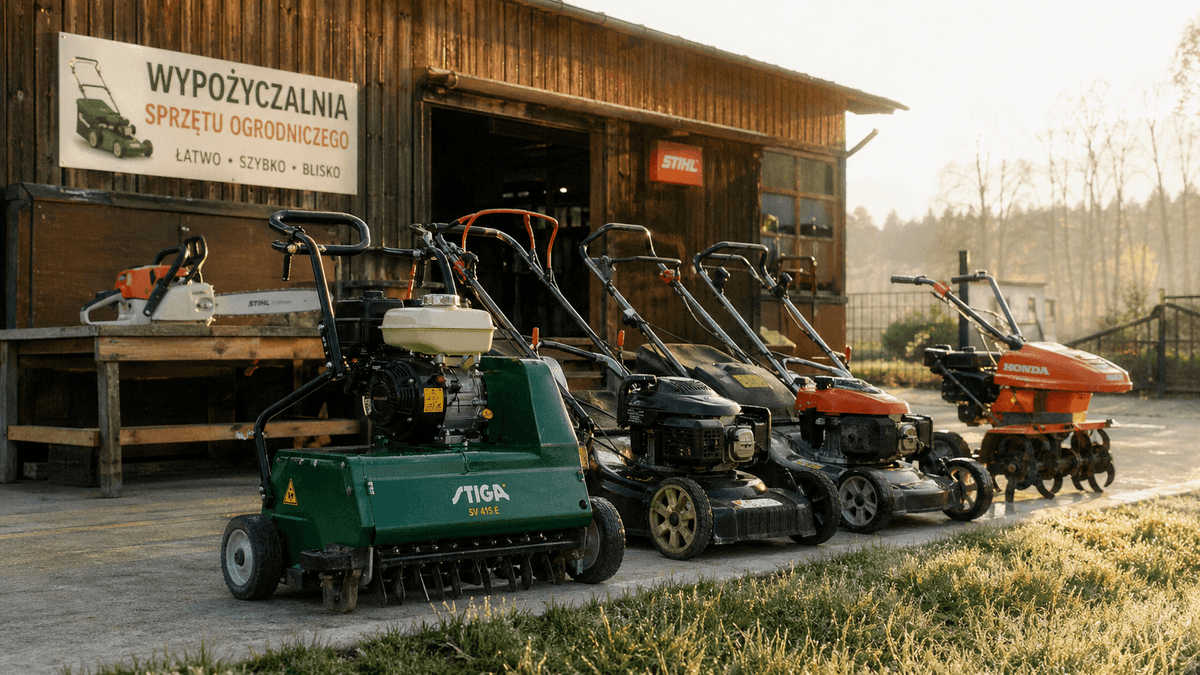
Paul's rental yard outside Aurora, Colorado runs all year. But it does 70% of its annual revenue in three months — from mid-April through the end of June.
This past weekend, 47 people called. Twelve of them walked away empty-handed because the aerators and dethatchers were already booked solid for the next week. Four ride-on mowers left the warehouse on Saturday morning and didn't come back until Sunday night.
Garden equipment rental season isn't just a busier version of normal. It's a fundamentally different operation, where logistics, reservations, and availability calendars decide whether you cash in or burn out.
Here are 8 steps to take in the next two weeks if you want to get through spring 2026 without losing customers to your competitors.
Step 1: Take inventory of availability — not units, but time slots
Garden customers don't ask "do you have a dethatcher?" They ask, "can I pick one up Saturday at 7 a.m.?"
That's a fundamental difference. The customer doesn't care how many dethatchers you own. They care how many will be free on the specific date they need.
So your first step isn't counting machines. It's setting up the availability calendar at the model level, not the unit level. Three identical Toro aerators are a single product to your customer, with "3 available" on a given day.
If you're already running a full annual inventory, this is the right moment to flag which units are ready to rent today and which still need spring service before they leave the yard.
Step 2: Turn on online reservations — without them, you're losing weekends
Garden season has one brutal truth: customers want to reserve Friday night for Saturday morning. Calling at 6 p.m., they hit voicemail. They call your competitor.
A "fill out this form, we'll get back to you Monday" website isn't a reservation system. It's a list of phone calls someone hasn't made yet.
A real reservation flow has to:
- Show real-time availability, not a static catalog
- Let the customer pick a date range with instant confirmation
- Display the price for the chosen window — no "we'll be in touch"
- Work on mobile — because 80% of weekend reservations are mobile
If your platform supports equipment reservations, make sure your public catalog lives at something like yourshop.com/r/yourshop. The customer should not have to log in, click through five screens, or enter a tax ID just to reserve a lawnmower for Saturday.
Step 3: Set up seasonal categories and feature your top 5 machines
You probably stock 80 products. The seasonal customer is shopping for five:
- Gas and battery lawnmowers
- Aerators and dethatchers
- Rotovators (rear-tine tillers)
- Wood chippers
- Trimmers and brush cutters
Everything else — generators, water pumps, grinders, mixers — speaks to a construction customer, not a homeowner. You're really running two storefronts for two different audiences.
Create a separate "Spring & Garden" category in your public catalog. Feature it on your homepage. Add filters by job type: "lawn", "garden bed", "trees & wood". The customer should find what they need in five seconds, not after scrolling through three pages.
Step 4: Set weekend pricing and protect yourself from Sunday returns
The seasonal customer doesn't rent by the day. They rent for the weekend — picking up Friday evening, returning Monday morning. A daily rate doesn't fit.
Price in three tiers:
- Daily rate — $50/day (Mon–Fri)
- Weekend package — $120 (Fri 2 p.m. through Mon 9 a.m., roughly 2.5 days)
- Weekly package — $250 (any consecutive 7 days)
The weekend package gives the customer a time-commitment discount (instead of $150 for three days, they pay $120) and gives you a guarantee that no one returns the equipment at 11 p.m. on Sunday when you're already asleep. Rental pricing is a tangled topic in general, but in garden rentals the rule is simple: a weekend is a weekend, not "two days."
Also bake protection into the rental agreement: a return after 9 a.m. Monday equals an additional day charged. Without that line, customers will hand the keys back at 11 a.m. and argue, "Well, it's still Monday."
Step 5: Plan the daily service rotation — equipment that doesn't roll doesn't pay
A rotovator that goes out at sunrise and stalls at hour five is a black hole. The customer's day is wrecked, the machine comes back damaged, and you miss the next reservation.
In garden season, service has to be daily and short, not monthly and deep. Every machine, after every return:
- 5 minutes — quick visual inspection (belts, oils, fasteners)
- 5 minutes — clean grass, mud, debris
- 2 minutes — check fluid levels (oil, fuel, battery)
- If anything's off — flag it as "service needed" in the system
For every 5 active machines, plan for 1 spare. Without a spare, you can't keep availability up when one unit goes down for service — and skipping equipment maintenance just means your customer hits an empty shelf at 7 a.m. on Saturday.
The customer who returns equipment Sunday at 10 p.m. saying, "I rinsed the grass off the blades but couldn't get to the belts" is not a loyal customer. That's a wasted Monday — the day the machine was supposed to go out to the next renter. Add a "post-yard-work cleaning state" line to your return checklist; it makes billing the cleaning fee straightforward.
Step 6: Build a "what to send out with the unit" cheat sheet
A dethatcher without instructions is a dethatcher that comes back broken. The customer doesn't know to set the working depth to 1/8" for the first pass. They don't know rotovators choke on rocks larger than 2 inches. They've never started a brush cutter and don't know where the choke is.
With every machine, send:
- One-page laminated quick guide — key points only, not the manufacturer's manual
- Service phone number — the one that's actually answered on weekends
- Common mistakes list — e.g., "dethatcher: if it bogs down in grass, lift, restart, lower"
- Return checklist — to be signed at handover
The return checklist is your evidence in any condition dispute. When a customer brings back a damaged unit and says "it was already like that," you have a signature and timestamped photos from before. Without it, you lose every dispute.
Step 7: Require deposits on equipment over $400
Compactors don't typically rent in garden season, but rotovators, ride-on mowers, and chippers do. That's $700–$4,000 worth of equipment. In 80% of cases it comes back fine. In 20%, it returns with minor damage — a broken hitch, a missing spark plug wrench, a torn belt.
A $50–$150 deposit handles 90% of those cases without drama. The customer has skin in the game; the equipment comes back in inspection-ready shape. You're covered for minor repairs without billing after the fact.
In garden season, take deposits on a credit card, not in cash. Cash deposits at 6 p.m. Friday are a security problem you carry through the weekend. A credit card hold is simply released after a clean return. If you handle deposits systematically, you already know this — but in seasonal rental, it's not optional, it's required.
Step 8: Measure what blocked reservations the most
Late May, run a quick audit:
- How many reservations did you reject due to no availability? (top 3 models)
- How many calls after 5 p.m. went unanswered? (check your call history)
- How many online reservations did customers abandon mid-flow? (check analytics)
If you turned away 30 dethatcher reservations in two weeks, next season you'll buy two more. If 40% of online customers drop off on the deposit screen, rethink the deposit amount.
Garden season gives you 12 weeks of data that normally takes 6 months to accumulate. Use it.
If you're working with a tight budget, invest in whatever had utilization above 90% last season. That tells you customers wanted it, but you couldn't supply it. A second unit of that machine pays for itself within a single season.
Three common mistakes garden rental shops make
Mistake 1: No availability calendar on the website. The customer calls, asks, hears "let me check, I'll call you back." You won't. They'll go elsewhere.
Mistake 2: One flat daily rate all season. In mid-April, people are dethatching their lawns. By mid-June, they're not. Peak-demand rates can and should be higher than off-peak.
Mistake 3: 9-to-5 hours during season. Garden work is after-work work. The customer picks up Friday at 6 p.m. and returns Monday at 7 a.m. Without flexible pickup hours, you lose your highest-revenue jobs.
Season is a test of your system, not your stamina
Wayne, who runs a similar yard near Cleveland, did all of 2025 manually — Excel calendar, phone, paper receipts. Season grossed $48,000. He repeated it in 2026 with online reservations and digital deposits in the system. Same staff, same fleet, but he handled 40% more rentals.
The fleet didn't change. The team didn't change. What changed was the layer the operation ran on.
Garden season isn't a test of your endurance. It's a test of your process. And the processes you don't intentionally design end up designing themselves — usually badly.
If you run a rental business — especially a seasonal one where spring and summer drive most of the annual revenue — these eight steps are the difference between a weekend earned and a weekend lost.
Open your public rental catalog before May
Toolero shows real-time availability, handles weekend reservations, and automatically authorizes deposits on a credit card. You can configure it in an afternoon and run it the next day.