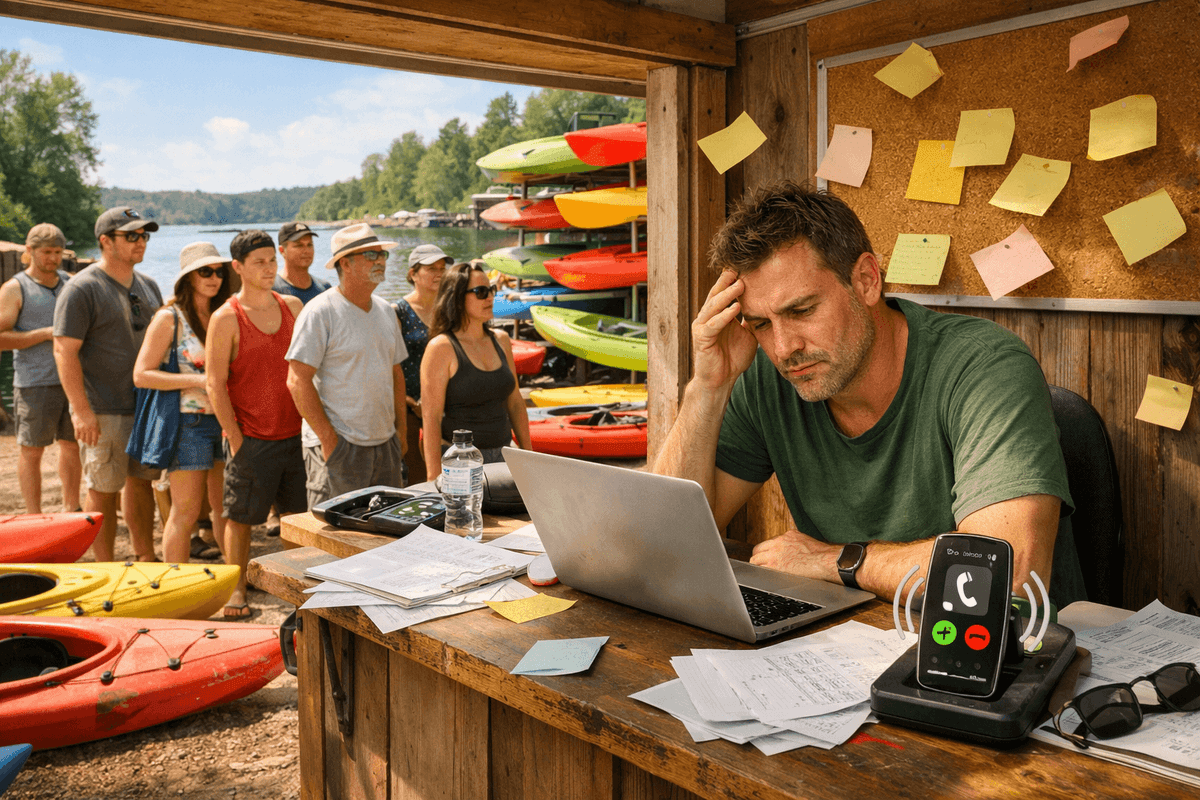
It is the second Saturday in July. The parking lot at Lake Cedar is already full by 9 AM. Mark unlocks the shutters of his kayak and bike rental shop, and there are already six people waiting in line. The sun is out, the forecast says 90 degrees, and his phone has been buzzing with reservation requests since dawn.
He opens his laptop, pulls up the spreadsheet. Three single kayaks reserved for the Kowalski family at 10 AM. He checks the rack — only one single kayak is there. The other two went out yesterday with a group that was supposed to return them by 6 PM. They never came back. No call, no text.
Mark looks at the line. Three families. Two couples. A group of college kids. All expecting equipment that does not exist right now.
This is the morning that changed everything.
The Season That Nearly Broke Him
Mark had been running Cedar Lake Rentals for four years. Kayaks, stand-up paddleboards, mountain bikes, and a handful of electric scooters. The business model was simple: earn enough between May and September to cover the entire year. Four months of revenue had to stretch across twelve months of bills.
For the first two years, things were manageable. He had maybe 8-10 customers on a good day. He kept track of everything in a Google Sheets spreadsheet — one tab for reservations, one for equipment, one for customer contacts. It worked. Sort of.
Then came year three. A new housing development went up across the lake. The town got featured in a "hidden gems for summer getaways" article. Suddenly, Mark was not getting 10 customers a day. He was getting 30.
And his spreadsheet did not scale.
What Manual Management Actually Looks Like at Scale
Here is the reality of running a seasonal rental on spreadsheets when demand triples:
| Task | At 10 Customers/Day | At 30 Customers/Day |
|---|---|---|
| Checking availability | Quick glance at the sheet | Scrolling through 50+ rows, hoping data is current |
| Taking reservations | Write it down, done | Phone ringing while you serve walk-ins, entries missed |
| Tracking returns | Mental note, maybe a checkbox | Equipment scattered, no idea what is back and what is not |
| Handling conflicts | Rare, easy to fix | Daily double-bookings, angry customers |
| End-of-day reconciliation | 5 minutes | 45 minutes of detective work |
The spreadsheet was not the only problem. It was the symptom. The real issue was that Mark had no system — no single source of truth for what was available, what was out, and what was promised to whom.
A spreadsheet is not a reservation system. It is a static snapshot that becomes outdated the moment you look away. In peak season, "outdated" can mean minutes.
The Day It All Fell Apart
Back to that July Saturday. Mark had to tell the Kowalski family — who had driven 45 minutes with three kids — that their reserved kayaks were not available. He offered them bikes instead. They did not want bikes. They wanted kayaks. That is what they reserved.
Mrs. Kowalski pulled out her phone. "I have your confirmation text right here. Three single kayaks, 10 AM."
She was right. Mark had sent that text himself. But between sending it on Tuesday and Saturday morning, someone had walked in on Thursday and taken two of those kayaks for a "quick two-hour paddle." They never came back on time. Mark forgot to update the sheet. The Thursday rental overlapped with the Saturday reservation. Classic double-booking.
The Kowalskis left. They did not come back. What they did leave was a one-star Google review:
"Reserved three kayaks a week in advance. Showed up and they had nothing. Complete waste of our morning. Do not trust the reservations here."
That review sat at the top of Mark's Google Business profile for the rest of the summer. He estimates it cost him dozens of customers who searched "kayak rental Cedar Lake" and saw one star staring back at them.
The Cascade of Consequences
That single incident was not isolated. Over the course of that summer, Mark experienced:
- 7 double-bookings in June and July alone
- 3 negative Google reviews mentioning unreliable reservations
- An estimated 40% of phone inquiries that never converted because he could not confirm availability on the spot
- 2 pieces of equipment that went unaccounted for over a week because nobody tracked who had them (relevant reading: what to do when a customer does not return equipment)
- Revenue down 15% compared to what the increased traffic should have delivered
The math was brutal. More people were coming to Cedar Lake than ever before. More people wanted to rent from him. And he was serving fewer of them than the year before — not because he lacked equipment, but because he could not manage what he had.
Seasonal businesses do not fail because of low demand. They fail because they cannot handle high demand. The bottleneck is almost always operational, not market-driven.
The Winter of Reckoning
September came. The crowds thinned. Mark sat down with his numbers and faced the truth. He had let the best season in four years slip through his fingers.
He spent that winter doing what he should have done before: researching how other rental businesses handled peak season. He talked to a friend who ran a ski rental in Vermont. He read forums. He looked at what larger operations were doing differently.
The patterns were clear. Businesses that thrived during peak season had three things Mark did not:
- Real-time inventory visibility — knowing at any moment exactly what is available, what is out, and when it is coming back
- A reservation system that prevents conflicts — not one that just records intentions, but one that blocks double-bookings automatically
- Customer accountability — proper verification, deposits, and automated return reminders
What Mark Changed
The following spring, Mark rebuilt his operation from the ground up. Here is what he implemented before the May opening:
1. A Central System for Reservations and Availability
No more spreadsheets. Mark moved to a system where every piece of equipment had a status: available, reserved, rented out, or in maintenance. When a customer reserved a kayak for Saturday at 10 AM, that kayak was blocked for everyone else. No ambiguity. No "I think it should be back by then."
Every reservation — whether it came by phone, Facebook, or in person — went into one system. Staff could see real-time availability at a glance and confirm bookings instantly. No more sticky notes, no more conflicting spreadsheet tabs.
2. QR Codes on Every Piece of Equipment
Mark printed weatherproof QR code stickers and attached them to every kayak, bike, and paddleboard. When a customer picked up equipment, staff scanned the code. When they returned it, another scan. The system updated instantly.
No more guessing which blue kayak was out. No more "I think that one came back yesterday." Scan in, scan out. Five seconds per transaction.
3. Automatic Return Reminders
The system sent customers a text message 30 minutes before their rental period ended: "Your kayak rental ends at 2:00 PM. Please return to the dock." If equipment was not scanned back in by the due time, Mark got a notification.
No more equipment vanishing for days because nobody noticed it was overdue.
4. Deposit and Verification Process
Mark stopped being casual about who he rented to. Every customer now provided a valid ID and a card on file. For equipment worth more than $300, he collected a deposit. The system kept customer history — so repeat visitors got faster service, while flagged accounts got extra scrutiny.
5. Maintenance Scheduling
Equipment in the water or on trails takes a beating. Mark set up a rotation: after every 20 hours of use, each kayak and bike went through a quick inspection. The system tracked usage hours automatically and flagged items due for maintenance. No more renting out a bike with a wobbly wheel because nobody checked.
The Results: Season Five
Mark opened for his fifth season in May with the same inventory — 12 kayaks, 8 paddleboards, 15 bikes, 6 scooters. Same parking lot, same lake, same town. The only thing different was how he managed it.
By the end of September, his numbers told the story:
| Metric | Season 4 (Chaos) | Season 5 (System) |
|---|---|---|
| Double-bookings | 7 | 0 |
| Negative reviews (reservation-related) | 3 | 0 |
| Average customers served per day (peak) | 22 | 31 |
| Average service time per customer | 12 minutes | 4 minutes |
| Equipment unaccounted for > 24 hours | 4 incidents | 0 |
| Google rating | 3.8 stars | 4.7 stars |
| Revenue (June-August) | $38,000 | $52,000 |
Zero double-bookings. Not one. The system simply would not allow it. If a kayak was reserved, it was reserved. If it was out, it showed as out. There was no room for human error.
The jump from 22 to 31 customers per day did not come from more equipment. It came from faster turnover. When service time dropped from 12 minutes to 4 minutes, Mark could process three times as many customers in the same morning rush. No paperwork shuffling, no spreadsheet hunting, no phone tag.
The Google reviews turned around. Five-star ratings mentioning "smooth booking" and "everything ready when we arrived" replaced the old complaints. By August, Mark was the top-rated rental on the lake.
The biggest revenue gain in a seasonal business often comes not from buying more equipment but from maximizing the utilization of what you already own. A kayak that sits on the rack because of a scheduling error earns nothing.
The Lesson
Mark's story is not unique. Every seasonal rental operator faces the same inflection point: the moment when demand outgrows the ability to manage it manually. Some hit that wall at 15 customers a day. Others at 50. But everyone hits it eventually.
The operators who survive are the ones who build systems before the wave hits — not after it crashes over them. They invest in the off-season so they can execute during the on-season. They treat their rental operation like a business, not a side hustle with a spreadsheet.
The ones who do not? They spend every summer putting out fires, apologizing to customers, and watching revenue leak through the cracks of a broken process. They work harder than anyone, and they have less to show for it.
Mark almost learned that lesson too late. He got lucky — his town kept growing, and customers gave him another chance. Not every rental business gets that second season.
If you run a seasonal operation — whether it is kayaks, bikes, ski gear, or beach equipment — the question is not whether you will outgrow your spreadsheet. The question is whether you will be ready when it happens.
The off-season is when you build the machine. The peak season is when you let it run.
If you want real-time availability, centralized equipment tracking, and zero double-bookings without building it all yourself, Toolero does it for you. 14-day free trial, no credit card required.