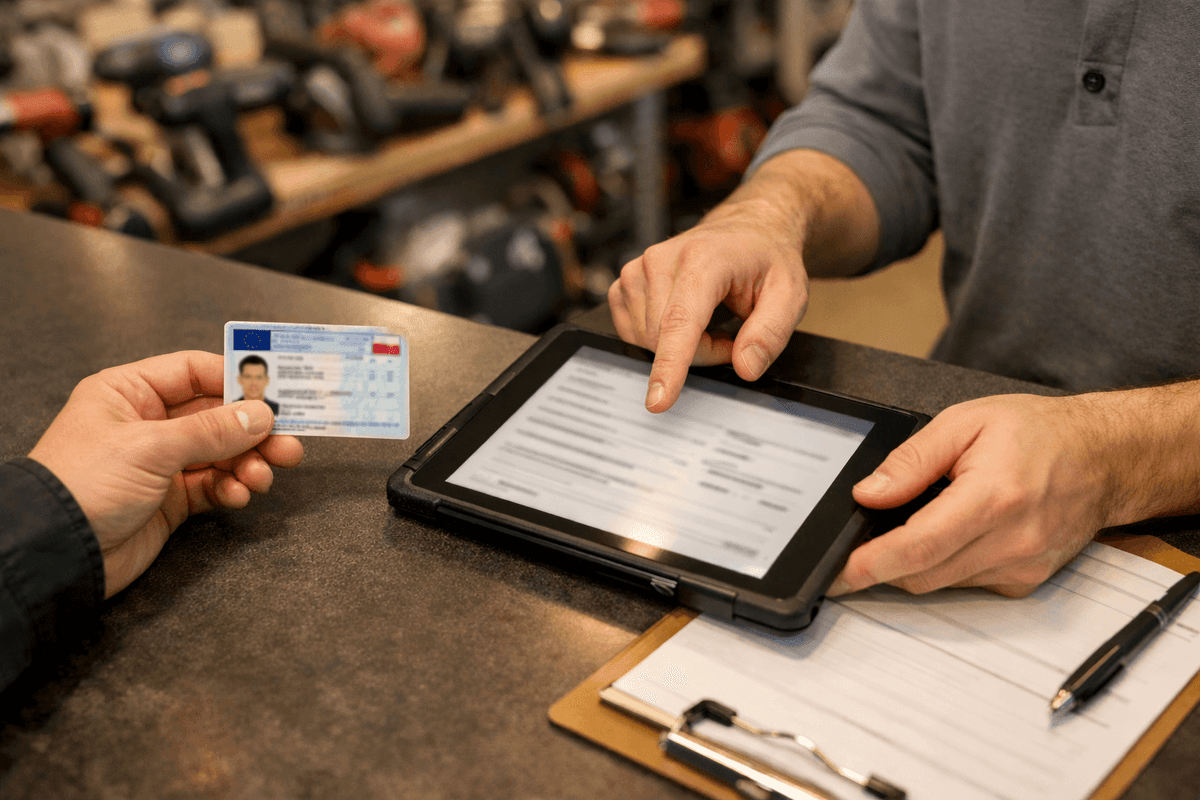

Wednesday, 6 PM. Mike from Cleveland is closing his rental shop and checking the return calendar.
A plate compactor worth $1,000 was due back Monday. Two days ago. Customer isn't answering calls. Text message — no response.
Mike knows this scenario. According to the American Rental Association, equipment theft and fraud cost the rental industry over $100 million annually in the US alone. And 40% of theft incidents involve people who had legitimate access to the equipment — often the same people who rent it.
This article is a complete guide: from the first phone call, through legal action, to prevention strategies.
Day 1: Call, Don't Text
On the first day after the due date, call. Texts are easy to ignore — a phone call demands a response.
"Hi, this is Mike from the rental shop. I'm calling about the plate compactor that was due Monday. When can I expect it back?"
Simple, professional, no accusations.
Most customers will apologize and set a new date. Some will ask for an extension — agree, but charge the extra fee. As per your rental agreement.
First Contact Scenarios
| Customer Response | Your Reply |
|---|---|
| "Sorry, I forgot. I'll bring it tomorrow." | Confirm the date, remind about late fee |
| "I need a few more days." | Agree + charge extension fee |
| "The equipment is damaged." | Get details, ask for photo documentation |
| "I don't have money for the late fee." | Equipment return first, fee negotiation later |
| Not answering / not calling back | Move to Day 2-3 |
Document every contact: date, time, what you agreed on. These notes could be crucial later.
Day 2-3: Written Notice
Phone isn't working? Time for an official paper trail.
Send email and text simultaneously:
Email Template — Return Notice
Subject: Equipment Return Notice - [equipment name]

Hello,

The [equipment name] was due [X] days ago ([date]).
Per our agreement #[number], I'm charging a late fee of $[amount]/day.

Current status:
- Days overdue: [X]
- Late fee accrued: $[amount]

Please contact me and return the equipment by [date, max 3 days].

If I don't hear from you, I'll take further action.

Best regards,
[Your name]
[Rental shop name]
[Phone]
Text Template
[Shop name]: Urgent - [equipment] was due [date].
Please contact: [phone]. No response by [date] = sent to collections.
Two channels increase the chance your message gets through.
Day 4-7: Certified Letter
Customer still silent. Now you need proof that you contacted them.
A certified letter with return receipt is the only way to prove in court that the customer received your notice.
Certified Letter Template
[City, Date]

FINAL DEMAND FOR RETURN OF PROPERTY

Rental Business:
[Name, address, EIN]

Customer:
[Name/Business name, address]

Re: Rental Agreement #[number] dated [date]

I demand the immediate return of:
- [Equipment name]
- Serial number: [number]
- Value: $[amount]

Return due date per agreement: [date]
Days overdue as of this letter: [X]
Late fees accrued: $[amount] ([X] days × $[rate])

Final deadline for return: [date, 7-10 days from mailing]

If you fail to meet this deadline:
1. Security deposit ($[amount]) will be forfeited
2. Police report will be filed (theft/conversion)
3. Civil lawsuit will be initiated

Please be advised that failure to return rented property
beyond the agreed period may constitute theft or conversion,
which is a criminal offense in most states.

[Signature]
[Business stamp]

Enclosures:
- Copy of rental agreement
- Copies of previous notices (email, text)
Keep a copy and the mailing receipt. That's your insurance policy.
What If Customer Changed Address?
Letter returned marked "addressee moved"? You have options:
- Check business registration — for businesses, addresses are public record
- Send to ID address — the contract address should match their ID
- Skip tracing services — for larger amounts (cost $50-150)
- Private investigator — for high-value equipment
For court purposes, what matters is that you tried to deliver. Keep the returned envelope.
After 7-14 Days: Legal Action
Deadline passed. You have four options — from least to most formal.
Option A: Collection Agency
Before going to court, consider soft collection. Collection agencies:
- Make calls, send notices, negotiate
- Commission: 25-50% of recovered amount
- No upfront payment — success fee only
When worth it: amounts $500-5,000, when you don't have time for DIY efforts.
When not worth it: when customer is clearly a scammer (collection won't scare them) or when amount < $300 (commission eats the profit).
Option B: Police Report
In most states, failing to return rented property beyond the agreed period constitutes theft or conversion — a criminal offense that can result in felony charges for high-value equipment.
When does late return become theft?
Law doesn't specify exact number of days. What matters is intent — did the customer intend to keep the equipment? Evidence of intent:
- No response to multiple notices
- Lies ("I returned it", "I never rented it")
- Attempt to sell the equipment
- Removal of owner markings
Bring to the police station:
- Rental agreement with customer signature
- Copy of customer's ID
- Copies of all notices and mailing receipts
- Equipment documentation: photos, serial number, purchase invoice
- System printout: rental history, non-return status
Police often call the debtor. A phone call from law enforcement works wonders — many customers return equipment within 24 hours.
Option C: Demand Letter from Attorney
Last step before court. You can send it yourself or through a lawyer (letter from law firm makes bigger impression):
Pre-Litigation Demand Template
PRE-LITIGATION DEMAND FOR PAYMENT

Pursuant to applicable state law, I demand payment of $[total]:

1. Value of unreturned equipment: $[amount]
   ([name], serial number [number])
2. Late fees for [X] days: $[amount]
3. Collection and correspondence costs: $[amount]

TOTAL: $[total]

Payment deadline: 7 days from receipt
Account: [bank details]

Failure to pay will result in civil lawsuit. You will also
be liable for court costs, statutory interest, and
attorney's fees.

Please be advised that failure to return entrusted property
may constitute criminal theft/conversion.
Option D: Small Claims Court
For amounts under $10,000 (varies by state), you can file in small claims court. Filing fee: typically $50-75.
| Element | Details |
|---|---|
| Filing fee | $30-75 depending on state and amount |
| Timeline | 1-3 months |
| Outcome | Judgment → collections/garnishment |
If you have solid rental documentation, the case is straightforward. Court sees the contract, notices, no response — issues a judgment.
Equipment Returned Damaged — What Then?
Separate problem: customer returned the equipment, but in condition that prevents further rentals.
Damage Procedure
- Document at return — photos, video, written report with customer signature
- Get repair estimate — invoice from service center or written estimate
- Deduct from deposit — if deposit covers costs
- Invoice for difference — if deposit isn't enough
Damage Report Template
EQUIPMENT RETURN REPORT - DAMAGE NOTED

Date: [date]
Equipment: [name], serial number [number]
Renter: [customer details]

Damages found:
1. [description of damage]
2. [description of damage]

Estimated repair cost: $[amount]
Security deposit paid: $[amount]
Amount due from customer: $[difference]

Staff signature: ____________
Customer signature: ____________

Note: Customer refusal to sign does not waive liability.
If refused, write: "Customer declined to sign"
When to Walk Away? Cost-Benefit Analysis
Not every case is worth pursuing. Simple calculation:
| Action Cost | Amount |
|---|---|
| Your time (10h × hourly rate) | ~$250 |
| Certified mail + receipt | ~$10 |
| Court filing fee (5% of $1,000) | $50 |
| Collection enforcement (if customer doesn't pay voluntarily) | ~$150 |
| Total costs | ~$460 |
Rule: if equipment value + fees < $500, consider stopping after the certified letter stage. Add customer to blacklist and move on.
For amounts > $1,000 — fight to the end. It sends a message to others that you don't give up.
Insurance — Will It Cover Losses?
Check your policy. Standard business insurance does not cover losses from dishonest customers.
You need:
- Fidelity insurance (covers employee and sometimes customer theft)
- Inland marine insurance with "mysterious disappearance" coverage
- Equipment floater with theft by bailee extension
Cost: 1-3% of equipment value annually. For a $50,000 fleet, that's $500-1,500/year.
Is it worth it? If you're losing more than 2-3% of fleet value annually to dishonest customers — yes.
GPS Tracking — Prevention and Recovery
More and more rental shops install GPS trackers in expensive equipment.
| Pros | Cons |
|---|---|
| Know where equipment is | Device cost ($50-150) |
| Can show police the location | Monthly subscription ($10-25) |
| Deterrent effect | Customer might remove (hide it well) |
Legal note: Inform customer in the agreement that equipment has GPS. Hidden tracking without knowledge may violate privacy laws.
Sample contract clause:
"Rented equipment is equipped with GPS tracking device for theft protection purposes."
Blacklist — Sharing Information
The rental industry is local. It's worth:
- Maintaining your own blacklist — in your rental system
- Sharing information with neighbors — other rental shops in town
- Checking customers before renting — do they have history
Privacy note: You can maintain records of dishonest customers for legitimate business purposes. But don't publish lists publicly — only internally and in closed industry groups.
Why Fast Action Matters
According to the National Equipment Register, recovery rates for stolen or fraudulently obtained equipment drop below 7% once the trail goes cold.
40% of equipment theft incidents cause project delays of 3-4 weeks. Every day you wait is another day your equipment could disappear permanently.
How to Prevent This
Mike from Cleveland learned his lesson. Now he does three things differently.
First: he verifies customers before renting. Scans ID, verifies phone (calls while customer is there), for businesses checks state registration.
Second: he collects proper deposits. For equipment under $250 — 100% of value. For pricier items — minimum 50%.
Third: he sends automatic reminders. 24 hours before due date, on the due date, day after due date.
Never try to recover equipment by force. Even if you see your compactor in the customer's yard — entering without permission is trespassing. Call the police instead.
Action Timeline — Summary
Day 1       → Phone call to customer
Day 2-3     → Email + text with notice
Day 4-7     → Certified letter with deadline
Day 8-14    → Collection agency OR police
Day 14+     → Demand letter → lawsuit
Document Checklist for Equipment Recovery
Before you start taking action, make sure you have:
- Rental agreement with customer signature
- Copy of customer's ID
- Proof of equipment release (signature, date)
- Equipment documentation (photos, serial number, value)
- Contact history (dates, conversation notes)
- Copies of sent notices
- Certified mail receipts
- System printout (rental history)
Most cases end at the first phone call. The tough ones require consistency and documentation.
Mike got his compactor back after 6 days. Customer apologized — "forgot." The $240 late fee was a good reminder not to forget next time.
If you want to automatically send return reminders and have complete contact history with customers in one place, Toolero does it for you. 14-day free trial, no credit card required.