Monday morning, a jobsite in Phoenix. An OSHA compliance officer walks up to a telehandler and asks for the inspection records. The site super opens the gang box — nothing. He calls the office. The office searches. An hour later, it turns out the records are "somewhere at the main yard" and the last documented inspection was... fourteen months ago.
Citation: $15,625. Equipment shut down: immediately. Cost of the delay: impossible to calculate.
This scenario plays out more often than you'd think. Construction companies and equipment rental businesses often don't know exactly which machines require documented inspections, what their obligations are, and what happens when they fall behind. This article is your complete cheat sheet.
Why equipment inspections matter beyond "just following rules"
OSHA doesn't maintain a registration system like some countries do. There's no government office where you "register" your forklift. But that doesn't mean you're off the hook — it means the burden of compliance falls entirely on you.
OSHA sets the standards. ANSI and ASME provide the technical specifications. Your insurance company reads the fine print. And when something goes wrong, all three come knocking.
The key principle: if a piece of equipment can seriously injure or kill someone when it fails, there are mandatory inspection requirements. Period.
Which equipment needs documented inspections?
The list is long, but for construction, manufacturing, and rental businesses, three groups matter most.
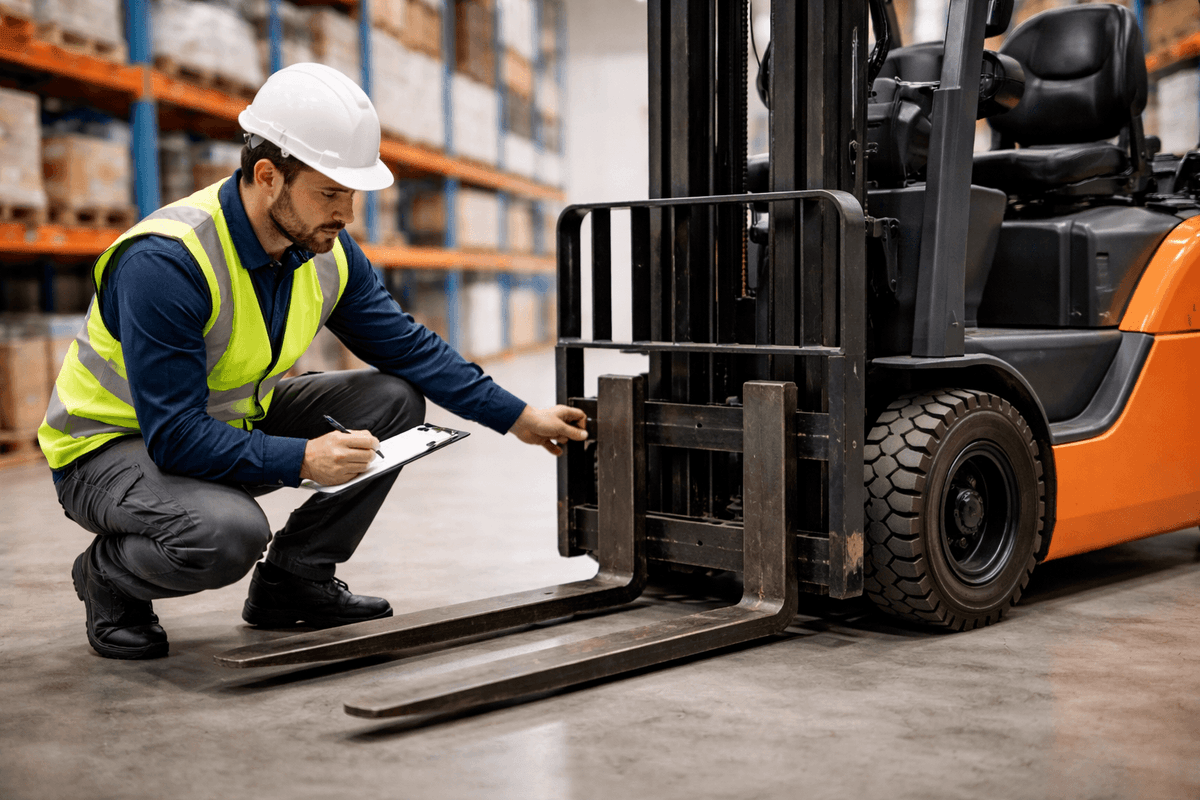
Powered industrial trucks (forklifts)
Governed by OSHA 29 CFR 1910.178 (general industry) and 1926.602 (construction).
Every forklift — sit-down counterbalance, reach truck, order picker, rough terrain — requires:
- Daily pre-operation inspection by the operator before each shift
- Periodic maintenance inspections per manufacturer's recommendations
- Documentation of all inspections and maintenance
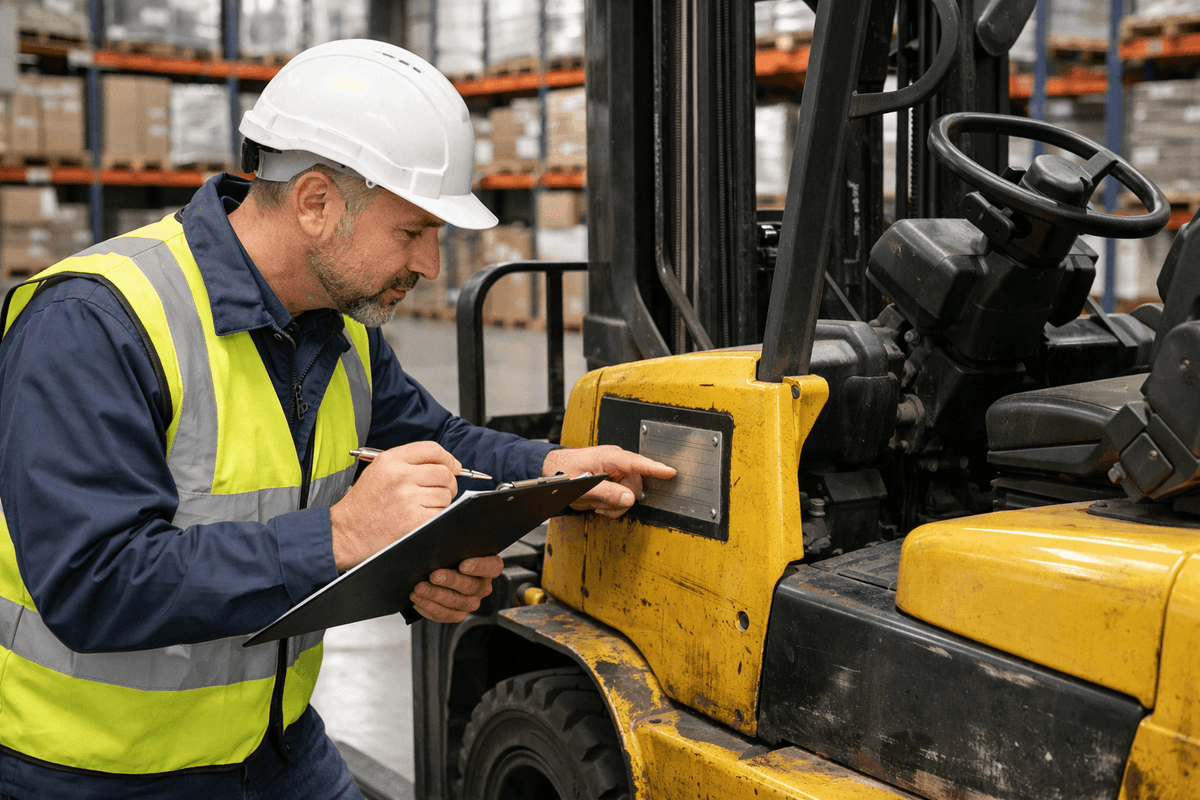
There's no annual "government inspection" like in some countries, but OSHA requires that forklifts are maintained in safe operating condition at all times. If an inspector shows up and your forklift has bald tires, leaking hydraulics, or no inspection logs — that's a citation.
Cranes and derricks
Governed by OSHA 1926 Subpart CC (construction) and 1910.179–180 (general industry). The most heavily regulated equipment category.
- Mobile cranes — annual inspection by a qualified person, plus monthly and daily checks
- Tower cranes — same, plus erection/dismantling oversight
- Overhead cranes and hoists — periodic inspections per ASME B30.2 / B30.16
- Boom trucks (knuckle booms, articulating cranes) — annual + pre-operation
An overhead hoist rated over 1 ton in your warehouse needs documented periodic inspections under ASME B30.16. Many shops run these for years without any inspection records — until OSHA shows up.
Aerial lifts and scaffolding
- Boom lifts and scissor lifts — daily pre-operation inspection + periodic maintenance per ANSI A92 standards
- Suspended scaffolds — inspection by a competent person before each shift
- Mast climbing platforms — periodic inspections per manufacturer specs
Pressure vessels and boilers
Governed by ASME Boiler and Pressure Vessel Code and state-level boiler inspection programs.
- Air compressors (stationary, above certain thresholds) — state boiler inspector, typically annual
- Boilers — annual or biennial state inspection
- Pressure piping — per ASME B31 standards
Most states have a Chief Boiler Inspector who enforces these. Requirements vary by state, so check your local regulations.
What are the actual inspection requirements?
Let's break it down by frequency.
Daily pre-operation inspections
Required for every shift on:
| Equipment | Standard | Who performs it |
|---|---|---|
| Forklifts | OSHA 1910.178(q)(7) | Trained operator |
| Mobile cranes | OSHA 1926.1412 | Trained operator |
| Aerial lifts | ANSI A92 | Trained operator |
| Overhead cranes | ASME B30.2 | Trained operator |
These don't require a special certification — any trained operator can do them. But they must be documented. A paper checklist or digital log. No documentation = no proof = OSHA citation.
Periodic / monthly inspections
| Equipment | Interval | Who performs it |
|---|---|---|
| Forklifts | Per manufacturer (typically monthly) | Qualified mechanic |
| Mobile cranes | Monthly (OSHA 1926.1412) | Competent person |
| Overhead cranes | Monthly (ASME B30.2) | Designated person |
| Aerial lifts | Per manufacturer (typically quarterly) | Qualified person |
Annual inspections
| Equipment | Standard | Who performs it |
|---|---|---|
| Mobile cranes | OSHA 1926.1412(d) | Qualified person |
| Tower cranes | OSHA 1926.1412(d) | Qualified person |
| Overhead cranes | ASME B30.2 | Qualified person |
| Pressure vessels | State boiler code | State inspector or authorized inspector |
| Boom trucks | OSHA + ANSI A10.31 | Qualified person |
Under OSHA, a "qualified person" is someone who by possession of a recognized degree, certificate, or professional standing, or by extensive knowledge, training, and experience, has demonstrated the ability to solve problems related to the subject matter. Your warehouse guy who "knows forklifts" may not qualify.
Who's responsible when you rent equipment?
This is the most common question from rental business owners and their customers. The answer depends on the rental agreement, but OSHA has clear baseline rules.
The equipment owner (rental company) is responsible for:
- Providing equipment in safe working condition
- Ensuring periodic maintenance is current
- Providing operator manuals and safety documentation
- Disclosing any known defects
The renter (customer) is responsible for:
- Daily pre-operation inspections
- Providing trained and certified operators (for cranes: NCCCO or equivalent)
- Using the equipment per manufacturer specifications
- Reporting defects and damage
If you run a rental business and send out a boom lift with a cracked weld or expired inspection — that liability doesn't transfer to the customer. Even if they didn't ask about inspection records.
Before every rental, verify the last periodic inspection date. If the inspection is due during the rental period, either complete it before delivery or establish in writing who arranges the inspection. Document everything.
A proper equipment handover protocol should include inspection status, last service date, and any known issues. It protects both parties.
Penalties — what happens when you don't comply?
OSHA doesn't play around. Penalty amounts were updated in 2024 and adjust annually for inflation.
Serious violation: Up to $16,131 per violation (2024 rates). This covers most inspection-related failures — missing documentation, uninspected equipment, untrained operators.
Willful or repeated violation: Up to $161,323 per violation. If OSHA determines you knew about the requirement and ignored it — or you've been cited before for the same thing.
Per-instance citations: OSHA can cite you separately for each piece of equipment that's non-compliant. Five forklifts with no inspection records = five separate citations.
Beyond OSHA:
- Insurance: Your carrier can deny a claim if equipment wasn't properly inspected. Read your policy.
- Lawsuits: In a personal injury case, the plaintiff's attorney will subpoena your inspection records. Missing records = negligence argument.
- Criminal charges: If a fatality occurs involving uninspected equipment, state prosecutors can bring criminal charges against company officers.
One missed inspection can cost more than a decade of compliance.
How to manage inspections across a fleet
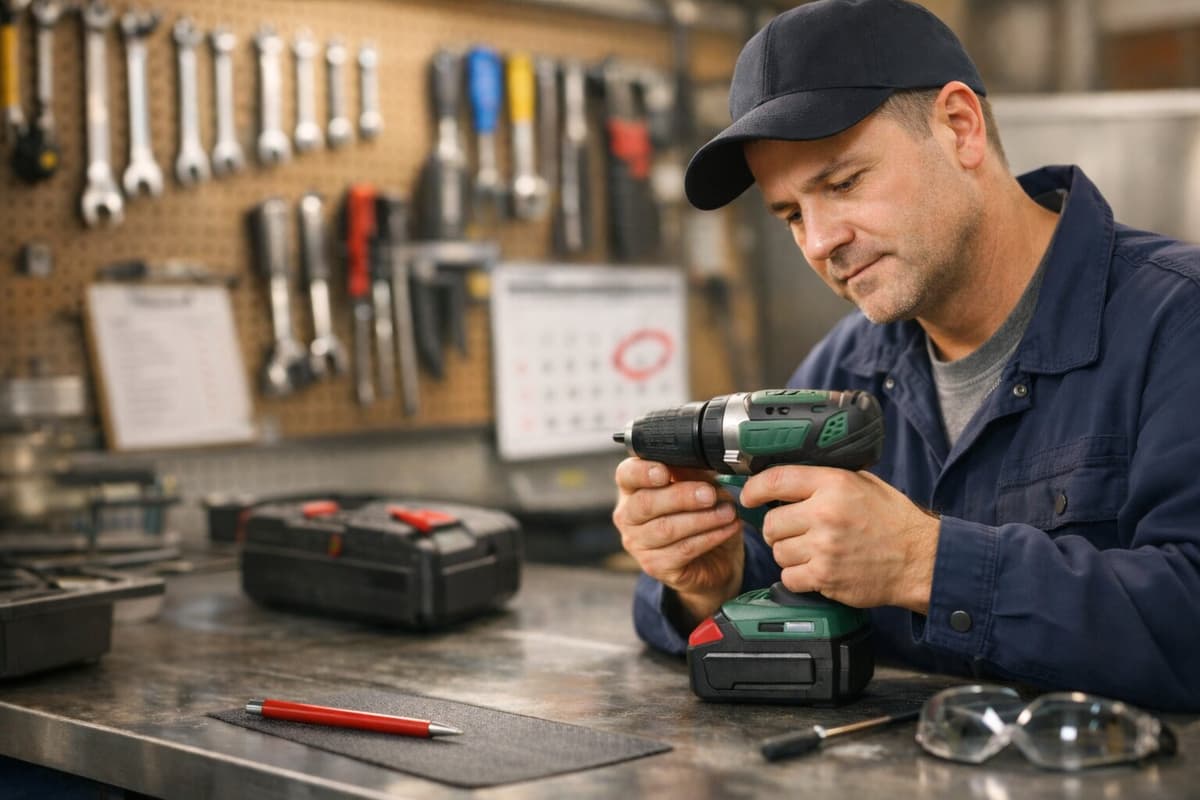
With 2–3 machines, a wall calendar works. With 10, 20, or 50 pieces of equipment across multiple jobsites — it falls apart.
The most common scenario: you've got a forklift at a warehouse in Cleveland, a boom lift on a job in Columbus, and two cranes on the road. Who's tracking that the forklift's quarterly service is due in three weeks?
Companies handle this three ways:
Spreadsheets — works up to ~10 machines. Problem: nobody updates it because the file lives on a computer at the office while the equipment is spread across the state.
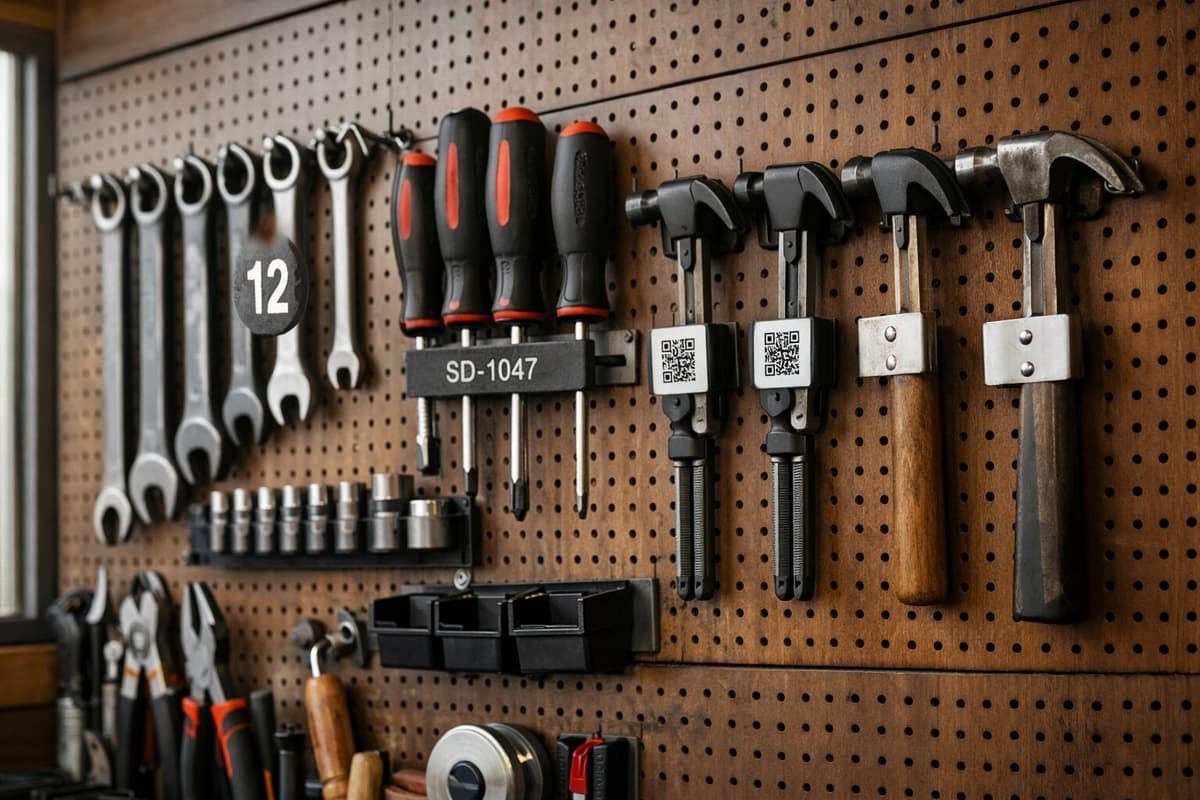
Dedicated system — equipment tracking with inspection schedules, automated alerts, and a history log for every machine. Every team member sees the status on their phone.
Third-party service company — outsource maintenance and inspection tracking. Expensive, but takes the problem off your plate.
Regardless of method, one rule matters: every piece of regulated equipment must have one person assigned to own its inspection schedule. If the answer is "everyone watches it" — nobody does.
Quick compliance audit — check your fleet now
Before you close this article, run through your equipment list:
- Does every forklift have documented daily pre-operation inspections?
- Are periodic maintenance records current for all forklifts?
- Do all mobile cranes have annual inspections by a qualified person?
- Are crane operators NCCCO-certified (or equivalent)?
- Are aerial lift inspections current per ANSI A92?
- Do overhead hoists/cranes have ASME-compliant inspection records?
- Are stationary compressors/boilers registered with the state boiler inspector?
- Can you produce inspection records within minutes — not hours?
If you hesitated on any of these — fix it today. Not tomorrow.
A comprehensive inspection and maintenance tracking system that covers OSHA requirements eliminates the risk of gaps. And if your equipment moves between jobsites, having every machine's history accessible digitally means you're never caught searching for paperwork during an inspection.
If you need a way to track inspection schedules, operator certifications, and maintenance history across your entire fleet, Toolero handles it automatically — alerts, history, and documentation for every machine. 14 days free, no credit card required.